
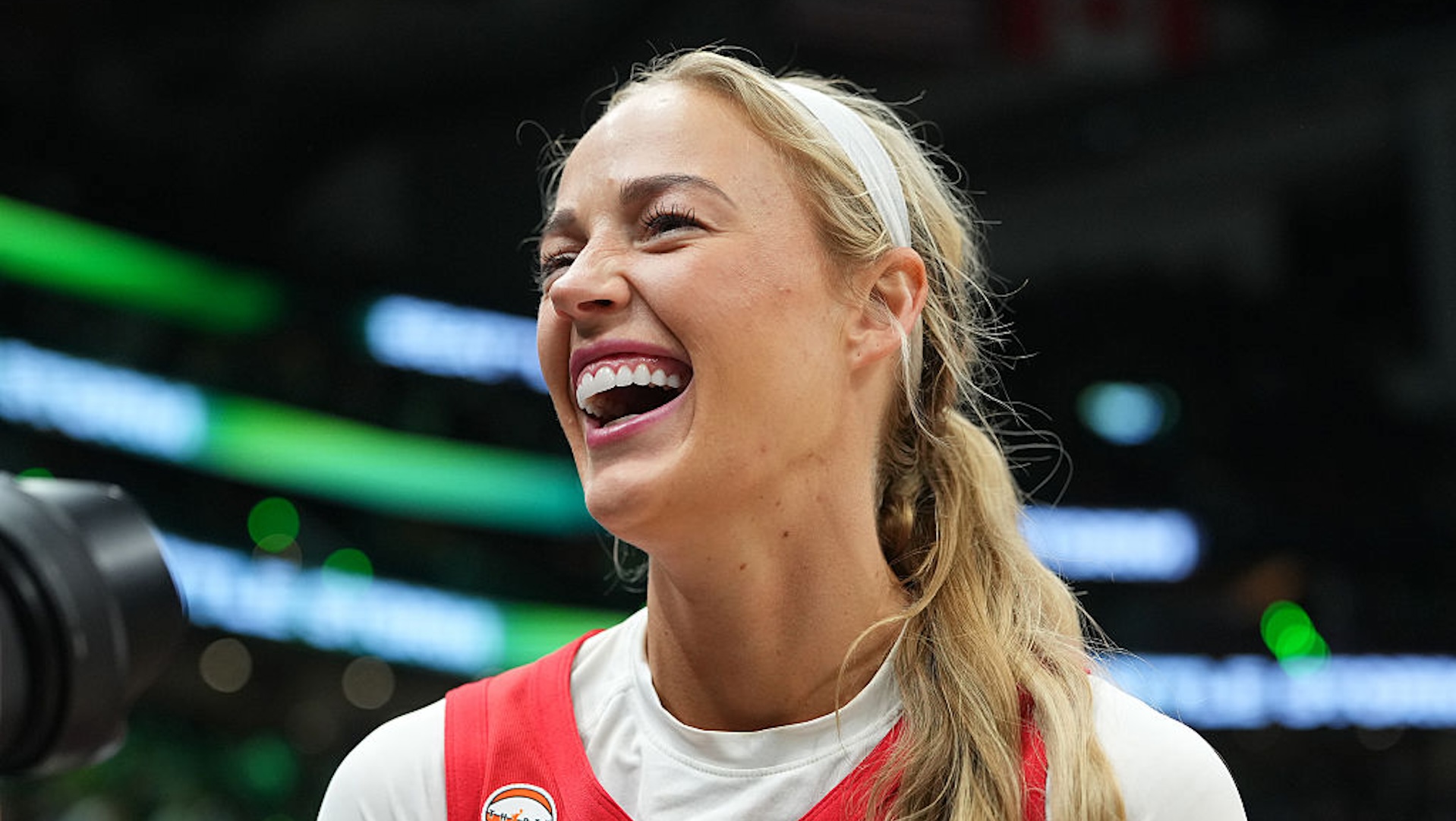
On Tuesday night, a small group of weirdos held an anti-trans rally outside of the Seattle Storm’s home arena. The occasion for their gathering was a game against the Indiana Fever and bench player Sophie Cunningham, who had recently participated in an ESPN profile where she said she wants to “protect young girls in a locker room, or young girls in sport who shouldn’t have to go against biological men.”
The rally seems like it was a dud, but the organizers got more of the attention they were after inside the arena. Sitting courtside during the game were two teen girls holding signs that read “Thank you Sophie for speaking up for girls,” and “We love you Sophie.” They were both wearing shirts from an apparel brand that donates money to anti-trans organizations. After the game, the two girls made a video with anti-trans agitator Brandi Kruse, in which they claimed they were told off in the arena by Storm minority owner Celeste Keaton. They said that Keaton told them they were “fucking insane.”
The Storm reacted to this accusation first by apologizing for Keaton’s actions, and then the WNBA fined and banned her from the team’s next five home games.
This is a private organization that can do as much censorship as they want. I don’t agree with it, but calling this a first amendment issue is the same tactic right wing chuds also use whenever they face consequences for their words. Drag the org’s name through the mud call them the pieces of shit they are, but don’t perpetuate the myth that the first amendment applies to any non-government entity. Thank you for coming to my ted talk and fuck TERFs.
“The first amendment” is a synecdoche for free speech rights in the US in general. Those don’t disappear when you step into a private space, rather the free speech rights are just balanced against property rights.
OK but. https://www.law.cornell.edu/constitution-conan/amendment-1/quasi-public-places
I would argue that the stadium, probably built with public funds, functions as a public space, and with the amount of public support for sports teams generally, I’d say theyre quasi-public too.
US courts would disagree with me at the moment (as the latter unquoted part of my link shows), but it’s not as farfetched a legal theory as you imply. And like I said before, “first amendment” is used as a phrase to talk about free speech generally, even if it’s not strictly making a constitutional legal argument. Its an ideal to be upheld
Tl;Dr: you’re 100% correct in the current political climate. But scotus cases can be overturned. https://en.wikipedia.org/wiki/Lloyd_Corp._v._Tanner is a more relevant case than marsh v Alabama, and it’s not set in stone (good luck getting the dictatorship of the bourgeoisie to overturn it, but it’s not crazy)
Yay I got to learn some nuance! Thanks for the sources.