

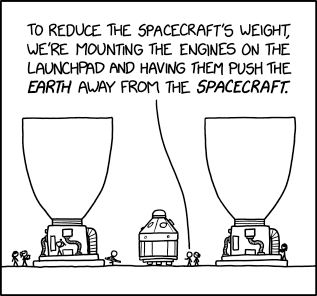
Title text:
It does come at the cost of some launchpad expansions and increased fuel requirements, but that all comes out of the facility’s budget.
Transcript:
Transcript will show once it’s been added to explainxkcd.com
Source: https://xkcd.com/3291/
Nah, it’s not that long a way. You just need to adjust your goals, add an extra stage, accept a much smaller payload.
If you can get a payload to space, you could put a payload 1/4 its mass into orbit with an additional stage.
I mean, the anti-sat F-15 test was pretty wild. But is arguably less wild than other airlaunch systems like the Pegasus or spaceship one. Saying that airlaunch is impossible is silly, because it’s happening.
These systems get cancelled because they’re expensive and complicated and reusable rockets are cheaper and easier.
They are saying a missile that went faster than, and tracked a target at orbital speed and velocity, can’t be reached… Obviously it can, or they’d miss everytime. Yet they shot it down using a rocket deploying a payload 41 years ago. Same shit, different payload.
thats not what i was saying at all. hitting an orbital object with a projectile is obviously possible. what im saying is that the velocity required to get a projectile in the right place at the right time is at least an order of magnitude less than the velocity required for it to be an orbital projectile.
It’s 1 moment to land am object that can land relative location with a small amount of fuel to readjust course. Like most other projectiles we shoot. On a scale of 1/10. If landing a shuttle on a landing pad is a 8/10 that’s. 3/10
ok so because you dont seem to be understanding the astronomical difference in velocity between a plane, a missile, and a satellite ill go through the comparison. in the most favorable possible terms. choosing the AIM-54 phoenix missile because its the fastest missile i was able to find with a quick search.
F15 maximum speed: 738 m/s
AIM-54 Phoenix maximum speed: 1700 m/s
Low earth orbit velocity: 8700 m/s
so adding the plane and the missile together we get 2438 m/s, which means the missile would need to gain 6262 m/s of additional velocity to reach orbital velocity. this corresponds to an 11.7 times increase in kinetic energy.
so the F15 flies up, works as hard as it possibly can to get to maximum speed, then shoots its AIM-54 phoenix missile which uses all of its fuel to get to its maximum possible speed, a tiny nudge for maneuvering is going to add 11.7 times more kinetic energy and nearly quadruple its speed… yeah that missile could hit a satellite, but it will never become a satellite itself.
all of this completely ignores the delta-v losses to gravity, steering, and drag required for an orbital insertion trajectory, so things get much much worse from here. if you’re actually interested in this i suggest you look up some youtube videos on orbital launch vehicles. or just believe whatever you want. the tyranny of the rocket equation is such that it doesnt really care what you think.
So let’s just say we had missiles that can go 9000 meters per second. (Russia, China and the the U.S. already do). You believe those are impossible as well? The term impossible is my problem with your statement.
Just because no one has shown a tool designed to do it yet doesn’t make it impossible. Your math showed it was possible.
The issues come down to weight and fuel sources used. Once you have the payload going in the speed/tragedy needed, yes it would need to be able to correct itself. When we launch 20+ satellites, they all have similar instruments in them, they aren’t all just dropped into 1 orbit
not that you could put on a plane lol, let alone an F15. look up the mass of one of those missiles and compare to the mass of an F15. you’re like mainlining copium right now its crazy.
Copium? What a nut job.
“Cars could never exist”
Have fun in life
air launch is dumb. it provides almost no benefit from a deltaV perspective while dramatically increasing the engineering cost and complexity of the launch system. just because people are working on it doesnt mean its going to be useful or practical or even work. even if it does eventually work for someone someday it wont be worth the effort or cost. theyll cancel it after a few launches or go out of business because no one can afford their overpriced copium machine.
Wouldn’t the main benefit to air launch be the elevation gain? Flight through wings is way more efficient than just raw thrust
I think the main advantage of air launch is there is less air in the way.
If you didn’t have any air resistance you could go faster earlier and reach orbit faster. This means less fuel wasted on fighting gravity, but because we have an atmosphere, there is a speed limit.
the elevation gain is a marginal benefit compared to the velocity required. no plane is going to give a meaningful velocity as a first stage, and at best will give not nearly enough altitude to matter, while severely limiting the maximum mass of the rocket.
just for some context, the energy to lift 1kg to an altitude of 500 km is 4.9 MJ (being extremely generous and assuming constant surface gravity), while the energy to accelerate 1kg to a velocity of ~7.6 km/s (the required velocity for a circular 500km orbit above the earth) is 28.9 MJ. so even if the plane could magically get the rocket all the way to altitude, it only saves about 14.5% of the energy required to achieve orbit.
practically speaking its likely impossible for a plane to get past the karman line (100 km) without the assistance of a rocket engine, and according to wikipedia the altitude record for a jet plane is only 37.6 km, which is only 7.5% of a 500 km orbit. its just way easier and cheaper to make a bigger rocket than to bother with putting a rocket on a plane.
I mostly agree. It’s not an efficient way to get to orbit.
It was an early attempt at reusable launch vehicles, it was a good idea, that turned out to be overcomplicated. The Pegasus 100% worked though, it went to orbit, so it’s not a question of “could it work someday”, it did work, it was just more expensive than the standard methods.
Again, I’m not saying this is an avenue worth exploring, I’m just saying that it’s incorrect to call it impossible.