If a religious layman is motivated by his religion to make policies that you don’t agree with you should not vote for that person. If anyone else agrees with his religiously motivated policies then they should be allowed to vote for that person. I don’t think this is too crazy of a concept. Now if that specific religiously motivated policy happens to be unconstitutional that is a totally different matter.
Is religious persecution and pogroms allowed in the constitution? Also systematically disallowing religious people from office is a form of religious persecution.
Mmmm, no that’s what the First Amendment is partially for. The government shall pass no law respecting the establishment of religion or prohibiting the free exercise thereof. I have a right to be a Satanist in peace without yokels shoving their way of life down my throat
If a lawmaker bans satanism or enacts a law that otherwise discriminates against satanists. Then that’s not allowed. But what wouldn’t be a problem would be a religious lawmaker on a totally secular subject. Like the example I gave in another comment how one could in theory loosen immigration restriction by quoting the parable of the good Samaritan. That law would not be religious law, even if the law maker was motivated by his religious belief.
It’s not too crazy of a concept but is absolutely not what separation of church and state means. It’s crazy that you think this is what it means.
You can’t have the majority forcing their religion onto the minority. That’s the exact reason we have separation of church and state. To protect the people who will never win an election.


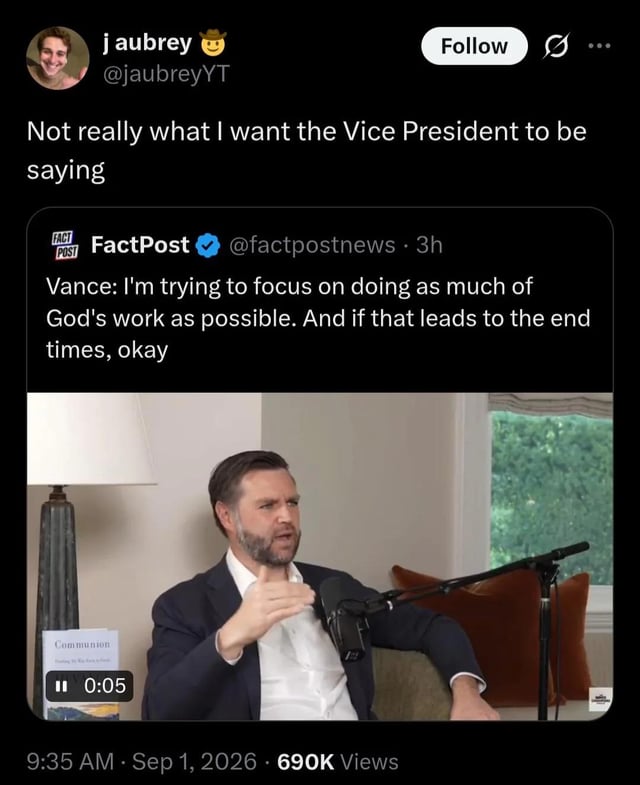
Are you saying it’s fine for elected religious laymen to force religion into our government and onto its people because they’re not church officials?
If a religious layman is motivated by his religion to make policies that you don’t agree with you should not vote for that person. If anyone else agrees with his religiously motivated policies then they should be allowed to vote for that person. I don’t think this is too crazy of a concept. Now if that specific religiously motivated policy happens to be unconstitutional that is a totally different matter.
This is how you end up with religious persecution and pogroms.
This is how you end with child rapism being legal in islamic countries, or how you get anti-queer and anti-atheist policies in most places.
Is religious persecution and pogroms allowed in the constitution? Also systematically disallowing religious people from office is a form of religious persecution.
Your “contitution” isn’t worth the paper it’s written on.
Go read a history book.
https://www.au.org/wp-content/uploads/2023/04/what-god-has-put-asunder.pdf
Read this, its from James Madison(he was one of your founding fathers).
Also:
https://www.au.org/wp-content/uploads/2023/04/madisons-memorial.pdf
And from Thomas Jefferson:
https://www.au.org/wp-content/uploads/2023/04/with-sovereign-reverence.pdf
Mmmm, no that’s what the First Amendment is partially for. The government shall pass no law respecting the establishment of religion or prohibiting the free exercise thereof. I have a right to be a Satanist in peace without yokels shoving their way of life down my throat
If a lawmaker bans satanism or enacts a law that otherwise discriminates against satanists. Then that’s not allowed. But what wouldn’t be a problem would be a religious lawmaker on a totally secular subject. Like the example I gave in another comment how one could in theory loosen immigration restriction by quoting the parable of the good Samaritan. That law would not be religious law, even if the law maker was motivated by his religious belief.
It’s not too crazy of a concept but is absolutely not what separation of church and state means. It’s crazy that you think this is what it means.
You can’t have the majority forcing their religion onto the minority. That’s the exact reason we have separation of church and state. To protect the people who will never win an election.