I’m not American so correct me if I’m wrong. But wasn’t the first amendment about disallowing the government from establishing or favoring a specific religious establishment. Meaning it would be illegal to say make a law that favors or teaches baptism in school at the expense of another Christian flavor. What I understand of the history behind freedom of religion in the US was that people were sick of the UK mandating the very specific theology of the Anglican church and instead wanting a system where people were allowed to practice any flavor of Christianity that they wanted. From this it would be no problem being a religious person in office but it would not be okay for that person to give benefits or favor to their specific church while in office.
Not making policy based on religious belief would be impossible however. One’s religion would impact one’s entire morality and value system. So one could say we should enact policy X because the bible says so. But one couldn’t say we should enact policy X because the southern baptist Convention just made a ruling that policy X should be enacted and now we have to make a law that matches that ruling.
Congress shall make no law respecting an establishment of religion, or prohibiting the free exercise thereof
It is as you said…primarily as a freedom to practice whatever religion you want…but this also effectively prohibits any government official from enacting any policy or legislation that promotes their own religious beliefs over any other, since it may conflict with the free practice of someone else’s religion.
In essence, it prevents the state from getting involved in religious matters altogether.
prohibits any government official from enacting any policy or legislation that promotes their own religious beliefs over any other, since it may conflict with the free practice of someone else’s religion.
Okay, so Christianity says we can’t kill people. But jihadism exists in Islam. Then the law must allow killing by Islamists to avoid being based on Christian beliefs and restricting jihadists’ practice?
Not exactly. Secular law supercedes religious law…and that is based on the concept of measurable harm. This is the concept that you cannot inflict measurable harm on another person against their will, without running afoul of the law in some way…whether it be a criminal or a civil violation.
However, there have been plenty of cases in the US where religious folks have argued…sometimes successfully…that their religious beliefs grant them an exception to secular law. But, unless local laws already make allowances for it, those cases always require a trial to determine whether that exception should be granted. And they are rare.
Secular law supercedes religious law…and that is based on the concept of measurable harm. This is the concept that you cannot inflict measurable harm on another person against their will
That’s a bold claim that it’s based on that concept, when there were and are plenty of laws that caused harm, and some of them are conspicuously based on Christian norms.
For example, both federal and twenty-six states’ law prohibit cannabis for recreational use while allowing alcohol. Some states prohibit abortion even in the case of danger to the mother. How was that harm measured?
Besides, why do you think that religious laws aren’t based on a belief in their moral utilitarianism? Just like modern laws don’t work on purely libertarian terms where one can’t limit another in any way except for self-defense, religious prescriptions also followed a perceived common good.
Some states prohibit abortion even in the case of danger to the mother. How was that harm measured?
That’s not harm measured and therefore is a bad law. Just as your example of “then law should allow Muslims to kill just not to be a Christian-based law”.
Basically, laws should be entirely based on science and reason, two things that are the opposite of any and all religions.
It feels like you’re trying to make the argument that if a system is somehow corruptible, then there should be no system at all. Is that how you view this?
Where did I say that? But, if you want a robust system, you should probably find a better definition than that handwavey, wishy-washy one in which holes are seen by an internet nobody in a minute. However, this vagueness tracks particularly with English/US law where lawmaking is delegated to the judges who can handwave things in and out as they see fit.
And, what’s certain is that Western law is based on Christian system of morality no matter how much you want it to not be.
Lol! You’re the one who “hand-waved” it away, like it’s some simplified slogan, that you clearly don’t understand.
Western Law isn’t “based” on Christianity. It’s based in logic, and philosophy. It holds that “truth” is based on evidence and objective facts…not faith or adherence to scripture.
It’s literally the exact opposite of religious law, which is dictated by decree, without evidence or rationality.
Sure bud. You produced a ‘definition’ that doesn’t work because it folds under slightest scrutiny, then you accused me of rejecting Western democracy while refusing to explain how your definition would work in practice, now you spout a bunch of empty proclamations worthy of an adolescent edgelord, while failing to grasp where the bulk of religious law comes from. And you say that it’s me who’s handwaving and doesn’t understand. Big ‘in this moment i am euphoric’ energy there. People like you are why online atheist movement is treated as a laughable circlejerk.
Also, US law is based on racism, bigotry, misogyny, self-centered backwardness and corporatocracy, along with ‘Christian values’. So you probably shouldn’t pipe up about that.
But I could in theory promote a secular policy based on my theoretical religious belief. Say I want to lower barriers to immigration and as motivation I quote the parable of the good Samaritan saying that even foreigners should be treated as ones neighbour. Now in doing this I’m letting my religious belief affect my policy making. However I’m not inhibiting anyone else’s free practice of religion since this is secular policy.
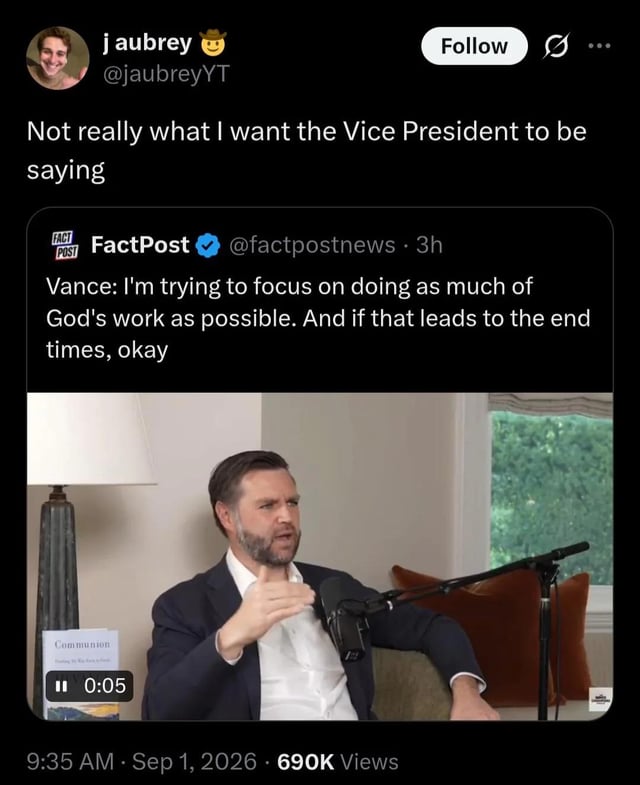
Yup. That’s all very true. But, when some idiot politician like JD here, straight up says the quiet part out loud, you can sue the government for all kinds of wrongful damages. Now, all of his policy positions can justifiably be scrutinized through this lens.
As for inhibiting anyone else’s free practice…that’s where the first amendment is most powerful. I have the right to not be governed by someone else’s religious beliefs. So, when JD here straight up admits that he’s governing based on his religious beliefs…that automatically means he’s infringing upon everyone else’s.


I’m not American so correct me if I’m wrong. But wasn’t the first amendment about disallowing the government from establishing or favoring a specific religious establishment. Meaning it would be illegal to say make a law that favors or teaches baptism in school at the expense of another Christian flavor. What I understand of the history behind freedom of religion in the US was that people were sick of the UK mandating the very specific theology of the Anglican church and instead wanting a system where people were allowed to practice any flavor of Christianity that they wanted. From this it would be no problem being a religious person in office but it would not be okay for that person to give benefits or favor to their specific church while in office.
Not making policy based on religious belief would be impossible however. One’s religion would impact one’s entire morality and value system. So one could say we should enact policy X because the bible says so. But one couldn’t say we should enact policy X because the southern baptist Convention just made a ruling that policy X should be enacted and now we have to make a law that matches that ruling.
It is as you said…primarily as a freedom to practice whatever religion you want…but this also effectively prohibits any government official from enacting any policy or legislation that promotes their own religious beliefs over any other, since it may conflict with the free practice of someone else’s religion.
In essence, it prevents the state from getting involved in religious matters altogether.
Okay, so Christianity says we can’t kill people. But jihadism exists in Islam. Then the law must allow killing by Islamists to avoid being based on Christian beliefs and restricting jihadists’ practice?
Not exactly. Secular law supercedes religious law…and that is based on the concept of measurable harm. This is the concept that you cannot inflict measurable harm on another person against their will, without running afoul of the law in some way…whether it be a criminal or a civil violation.
However, there have been plenty of cases in the US where religious folks have argued…sometimes successfully…that their religious beliefs grant them an exception to secular law. But, unless local laws already make allowances for it, those cases always require a trial to determine whether that exception should be granted. And they are rare.
That’s a bold claim that it’s based on that concept, when there were and are plenty of laws that caused harm, and some of them are conspicuously based on Christian norms.
For example, both federal and twenty-six states’ law prohibit cannabis for recreational use while allowing alcohol. Some states prohibit abortion even in the case of danger to the mother. How was that harm measured?
Besides, why do you think that religious laws aren’t based on a belief in their moral utilitarianism? Just like modern laws don’t work on purely libertarian terms where one can’t limit another in any way except for self-defense, religious prescriptions also followed a perceived common good.
You’re mixing apples with pears there…
That’s not harm measured and therefore is a bad law. Just as your example of “then law should allow Muslims to kill just not to be a Christian-based law”. Basically, laws should be entirely based on science and reason, two things that are the opposite of any and all religions.
It feels like you’re trying to make the argument that if a system is somehow corruptible, then there should be no system at all. Is that how you view this?
Where did I say that? But, if you want a robust system, you should probably find a better definition than that handwavey, wishy-washy one in which holes are seen by an internet nobody in a minute. However, this vagueness tracks particularly with English/US law where lawmaking is delegated to the judges who can handwave things in and out as they see fit.
And, what’s certain is that Western law is based on Christian system of morality no matter how much you want it to not be.
Lol! You’re the one who “hand-waved” it away, like it’s some simplified slogan, that you clearly don’t understand.
Western Law isn’t “based” on Christianity. It’s based in logic, and philosophy. It holds that “truth” is based on evidence and objective facts…not faith or adherence to scripture.
It’s literally the exact opposite of religious law, which is dictated by decree, without evidence or rationality.
Sure bud. You produced a ‘definition’ that doesn’t work because it folds under slightest scrutiny, then you accused me of rejecting Western democracy while refusing to explain how your definition would work in practice, now you spout a bunch of empty proclamations worthy of an adolescent edgelord, while failing to grasp where the bulk of religious law comes from. And you say that it’s me who’s handwaving and doesn’t understand. Big ‘in this moment i am euphoric’ energy there. People like you are why online atheist movement is treated as a laughable circlejerk.
Also, US law is based on racism, bigotry, misogyny, self-centered backwardness and corporatocracy, along with ‘Christian values’. So you probably shouldn’t pipe up about that.
Wtf… You have -∞ IQ.
What they mean is that neither Christian-based nor Islamic-based (and in general religious-based) laws shouldn’t be passed.
But I could in theory promote a secular policy based on my theoretical religious belief. Say I want to lower barriers to immigration and as motivation I quote the parable of the good Samaritan saying that even foreigners should be treated as ones neighbour. Now in doing this I’m letting my religious belief affect my policy making. However I’m not inhibiting anyone else’s free practice of religion since this is secular policy.
Yup. That’s all very true. But, when some idiot politician like JD here, straight up says the quiet part out loud, you can sue the government for all kinds of wrongful damages. Now, all of his policy positions can justifiably be scrutinized through this lens.
As for inhibiting anyone else’s free practice…that’s where the first amendment is most powerful. I have the right to not be governed by someone else’s religious beliefs. So, when JD here straight up admits that he’s governing based on his religious beliefs…that automatically means he’s infringing upon everyone else’s.
Keep your stories out of secular law please. We will enact no law that favors religion(or uses any part of it).