

2·
21 hours agoWhat did you expect people to say? Here in Germany, at least, this lines up with what any reasonable person would expect from our government parties. It’s not like people didn’t know what they were voting for.
What did you expect people to say? Here in Germany, at least, this lines up with what any reasonable person would expect from our government parties. It’s not like people didn’t know what they were voting for.

Stuff I can do myself perfectly well, but the results - after postprocessing - are indistinguishable from me having done so. Even when accounting for everything (including hallucinations) the time savings are real: Renewables-powered electricity is cheaper than my attention. By a lot.
Caveat: This only works if you’re already a domain expert and if you do it exclusively for too long, you might be at risk of ceasing to be such an expert. Don’t use it to try and do the thinking for you.
Proprietary frontier LLMs in companies riddled with highly suspect business practices.
My local LLM setup has absolutely been making the equivalence of positive cashflow for me since gemma 4 and qwen 3.8: I need less total time for several groups of annoying (but necessary) tasks, which means my productivity is up and I can use the rest as my own free time.
Yikes. I mean, I get that not everyone’s threat model requires isolating every agent harness into its own microvm jail with externally filtered network access and no [persistent filesystem] write access to anything but allowed project files, but that’s…
That’s “running with weapon in hand at a secret military facility and hoping the guards won’t shoot you” levels of stupidity.

How tf this even gets patented?
It hasn’t, yet, afaict. Applying for a patent != it being granted.
As to the latent question of why Microsoft seems confident enough to try:
Because the times of a patent requiring to clear a reasonable inventive threshold (to actually be a motor for innovation) are far behind us. These days, patents’ principal (not exclusive) purpose imho is so big corporations can sue each other to grab some of the others’ earnings.

Maybe I’m too sleep deprived, but why does “built from two blueprints” equal “is two organs”? When the two base components fuse they become one self-contained unit.
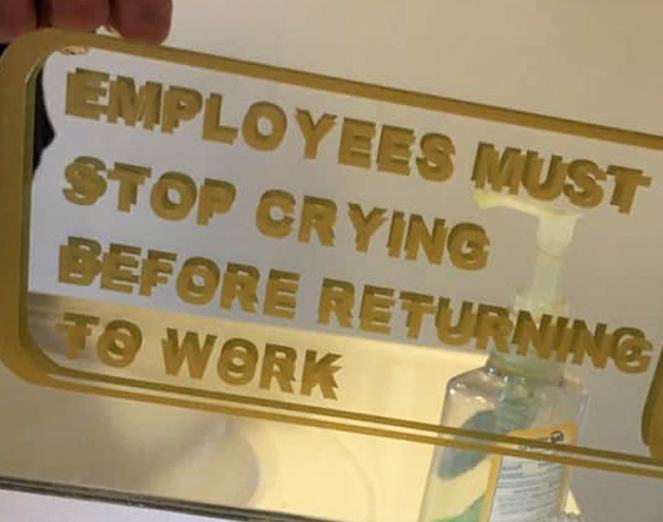
Because only the sound of orphans being crushed can fill the dragon’s empty heart with joy. Collectively, we could defeat it, but it might burn down all the land in the fight…
Also, most people cheer for the sacrifices - it’s not their children, after all.
but maybe define “social contributions”
Very roughly: Money taken out of your salary, which goes into health insurance, pension insurance, nursing care insurance, and unemployment insurance, as well as some other minor specialized levies like U1 (to fund part of your income in sickness), U2 (to fund part of your income in motherhood), and U3 (to fund part of your income in case your employer goes insolvent). For most people, they are typically all mandatory.
About half of the first three plus U1, U2, and U3 are taken out of your “total” salary as the employer sees it (they are part of the total cost of your labor). The rest is taken out of the “gross” amount you see on your salary statement (the cost you agreed to in your work contract)*. That’s why there are two differently shaded turquiose areas in the graph.
The full details are more complicated.
* Most people here in Germany don’t even know about these additional levies, as they don’t show up on your income statement. Same as the half subtracted before the gross (“before taxes”) number you see on it; plenty of people still think “the employer pays the other half of my social contributions”, which is only correct if you don’t consider the total mandatory cost of your labor your salary - which imho is asinine, because that’s the value your labor must exceed in order to stay employed long term.
VAT has a function.
The function of a system is what it does in the standard case, under normal operating conditions. As a flat tax on consumption, it is a regressive tax, meaning what it does is it affects poorer people more, because virtually the entirety of their income has to go into consumption. All else being equal, it strongly contributes to the current situation where most of them will never be able to save enough money to become not-poor. This is what the graph linked to earlier shows: The higher your income, the less you care about VAT. Thus, if you want to slow down the redistribution of wealth from poor to rich, reducing VAT (at the very least for staple foods, for which there is already a separate tax rate that you just have to lower to 0%) is the fastest way to do so within the bounds of tax&levy policy.
Are you pleading for it to be lowered for everybody?
Yes. If you really don’t want higher income people to profit from this at all, increase the income tax rate for the highest 5% by just enough to compensate for it, which currenly is very roughly somewhere around 130k EUR gross per year.
And your point 3 is already in what I said “They should get rid of the income tax and just have a wealth tax.”
I’m saying: In Germany, reducing the income tax (the lower brackets, specifically) comes in (a very distant) third place among the things one should do to alleviate most people when it comes to taxation & levies. If you just reduce income tax, you don’t affect poor people much at all, because most of them already pay little to no income tax.
Are the measures you’re suggesting in addition to what I said or place of it?
“In place” of the reductions, and only for Germany, because that’s what the linked statistics shows for it:
A different illustration for the same data is here, where vat = blue, social contributions = grey (dark+light), and income = red.
Personal note: This is imho why right-wing parties in Germany are always talking about reducing income tax. Because they know it sells well to the electorate while doing the least for most of them.
** Rougly eyeballed from the illustration, don’t quote me on the numbers.
The data is very clear. See in particular in terms of how people need to be relieved:
In that order. Note that lower social contributions can (and should) just be balanced via the federal budget.
But since people vote for parties that will never do this and all but ignore parties that would, people will continue to get screwed.

Apparently you can’t fucking read. […]
That would be you, because you keep being wrong with virtually every single line. Here’s how it goes with pseudosignatures:
You make an account with Valve. Valve has previously received the appropriate certificate to perform age verification from the state, so Valve does not communicate with the state now: They present their certificate to the hardware chip in YOUR ePerso, which then creates a pseudonymous signature to send back to Valve that digitally proves the legal age of whoever the ePerso belongs to (and nothing more).
But go ahead and keep licking that technofascist boot.
No thanks, but you go right ahead - someone entrenched in blind ideology is for sure not an ideal mark.
Have you even bothered to do any research at all into what pseudosignatures are and how they can be used? Or are you just trolling?
Valve could simply set up an instance of an eID server software and get a digital certificate for it authorized by our respective national PKI chain. Functionally the same to how TLS certificate chains work. There is zero technical need for any information to flow between Valve and any other party - the state or otherwise - about who is being age verified. And Valve would not be able to get any information about you other than what I’ve already explained.
Seriously, the brainrot on here seems to be as bad as on Reddit. And btw: This has been state-of-the-art for more than ten years.
I agree that social hierarchies are a feature of homo sapiens, hence why any good form of governance should be based on restricting our worst instincts. That’s what the original liberalism improved with the separation of political power into executive, legislative, and judicate branches. Unfortunately, the same was not done for economic power, which - most liberal democracies - allowed to keep concentrating with few to no safeguards.
The eID of the ePerso supports pseudosignatures, which allows the seller to only get to know “This ePerso belongs to someone of legal age who also knows its PIN” and the state to only know “someone I [the state] authorized to perform age verification did so”. That is privacy-preserving by any reasonable measure.
They’re not. The seller just has to verify customer age, same as when e.g. buying alcohol in the supermarket or entering a gambling hall.
Valve has simply been refusing to do so, even though eID makes privacy-preserving age verification trivial, frankly.


If you want to do the least amount of tech support: Fedora Kinoite.