
- cross-posted to:
- [email protected]

- cross-posted to:
- [email protected]
A Harpers contributer does the legwork and gets a head start on deflating the next dumb hype cycle.
You must log in or # to comment.
Two things, first thinking the llm stuff will help in robotics doesnt seem to fly, as llms are based on the whole internet and all books, a massive amount of data, data which for menial tasks doesnt exist yet. (And is also harder to get, creating text is easy).
And the story about how humanoid bots are great for working in a warehouse seems also wrong to me, as one of the problems we all have had is that of you are carrying things, the big box you are carrying obscures part of your vision. Different designs would be better for that. (Even a humanoid robot who has eyes on the back of its hands for example). Such a lack of imagination.
E: mentioned the lack of data being an issue, but I realized it prob is even worse as we dont even have a proper language to describe a lot of movements and feelings, due to reading this https://archive.is/uxzgz
you want something to help you in warehouse work? we have a tool for that: it’s called forklift
Hello I would like a mechanical slave
they have played us for absolute fools
But paying workers gives workers money, which means you lose. Instead of buying a robot, which gives another capitalist/company money, which means they win. They are the most class conscious class.
They had robots in galts gulch, which means that all businesses need them. If you aren’t randmaxxing 24/7, can you really call yourself a technological visionary at the vanguard of the libertarian master race?
“vangaurdist libertarians” is so cursed
Did they? Dont think Rand thought that far and the robots were fan fiction.
I can’t find any good sources right now, I’m absolutely not going to find a copy of that particular screed and look up the relevant bits, but I think the oil wells in galts gulch were automated, with self driving trucks, I think? It might also be implicit in the goods that are produced there, but that is drifting a bit into fanfic, I admit.
Anyway, between boston dynamics and the endless supply of rand fans on the internet, it’s very hard to research without reading the damn thing.
If I find a new source, I’ll report back.
I might be able to borrow a digital copy and run a search through it, but im afk for now.
So, curse you for making me check the actual source material (it was freely available online, which seems somehow heretical. I was intending to torrent it, and I’m almost disappointed I didn’t have to) and it seems I’m wrong here… the anconia copper mine in the gulch produced like a pound of copper, and they use mules for transporting stuff to and from the mine. The oil well is still suspicious, but it just gets glossed over.
I’m not prepared to read any more than that, so if there was anything else about automation in there I didn’t see it. I’d forgotten the sheer volume of baseless smug that libertarian literature exudes.
data which for menial tasks doesnt exist yet.
This reminds me over an old old furore here in Sweden. A female researcher at a largish university made a study of how cleaners … cleaned. How bathrooms, kitchens etc were constructed and how workers had to move and lift to do their work.
This was almost universally derided - “who does science on cleaning???”, but of course the intent was serious. Lots of people clean, if we design better workspaces, we reduce injuries and RSI etc, and maybe make it easier for less skilled people to clean. But becaseu both the author and the subjected were coded female, the reactionaries had conniptions.
Anyway that won’t help humanoid robots. Just thought about it
Edit found an article in Swedish about it, year was 1985. Nowadays bathroom fixtures are constructed after her recommendations
https://arbetet.se/2009/02/26/gudrun-linns-forskningpverkar-hela-byggsverige/
Sounds a bit like a Swedish heiress to Lillian Gilbreth. My wife has had some mobility issues and has lamented that the work that went into designing more ergonomic and accessible kitchens in the 40s and 50s was largely abandoned and ignored in more recent homes.
In addition to jointly running Gilbreth, Incorporated, their business and engineering consulting firm, Lillian and Frank wrote numerous publications as sole authors, as well as co-authoring multiple books and more than fifty papers on a variety of scientific topics. However, in their joint publications, Lillian was not always named as a co-author, possibly due to publishers’ concerns about naming a female writer. Although her credentials included a doctorate in psychology, she was less frequently credited in their joint publications than her husband, who did not attend college.[11][25]
Infuriating
Of all the environments that you might want to rearrange to facilitate non-humanoid labour, surely warehouses are the easiest. There’s even a whole load of pre-existing automated warehousing stuff out there already. Wheels, castors, conveyors, scissor lifts… most humans don’t have these things, and they’re ideal for moving box-like things around.
Industrialisation and previous waves of automation have lead to workplaces being rearranged to make things cheaper or faster to make, or both, but somehow the robot companies think this won’t happen again? The only thing that seems to be different this time around, is that llms have shown that the world’s c-suites are packed with deeply gullible people and we now have a load of new technology for manipulating and exploiting them.
The part about robots doing backflips causes the robot to wear down faster has me thinking the whole “replace humans with humanoids” should be framed as comparative advantage rather than how many robots would be required to build itself. Given the number of humanoids required to replicate itself, you could take those same complex parts, rearrange them into non-humanoid configurations and have more output both in an interval of time and over the life time of those parts.
IMO, this grift is enabled by the miniaturization of brushless motors. It’s been a bit of an underreported revolution, but the improvements are super obvious for anyone who has handled power tools in over the last 10 years; it’s also a big deal for combat robots. You just get so much more power per kilogram of motor. These guys are lazy, so they didn’t think to consider the wear from that kind of loading in their designs.
So the grifters just CAD up a believable people-shaped chassis, plonk in these new ittybitty motors, warm-over 20 year old dynamic stability research, have a few guys dance around in knitted gimp suits for the camera, and voila, they can vacuum up money from scifi-pilled rubes for years before vanishing.
Edit: also I can promote my niche hobby horse here: I maintain that Tombstone from the Battlebots tv series is the ultimate answer to these things (as well as skeleton hordes and zombie mobs).
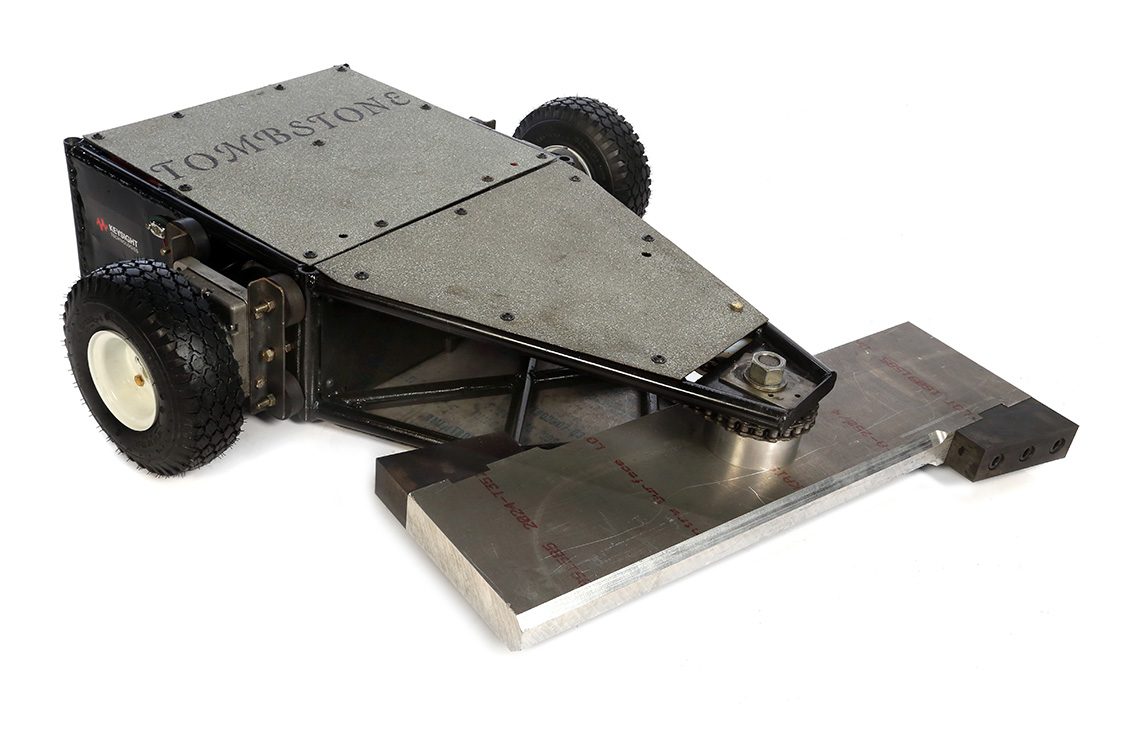
is there a term I can google to start researching this new generation of motors?
I guess battery tech has affected this too
I’m not sure, alas. I’m only a hobbyist. It seems that improved brushless motors is a direct follow-on of the mass production of high-strength rare earth magnets, the motors being my main point of contact. (you can also draw a straight line from this to the rapid development of drones and quadcopters when combined with high capacity batteries, as you pointed out. )
In my experience, pinning down exact comparisons between brushed and brushless motors is a source of frustration since brushless torque curves behave counterintuitively at low speeds, e.g. the second chart you see here:
https://www.fingertechrobotics.com/brushless-torque.php
That behavior is why you can’t find a torque vs current draw curve for brushless motors. You can get an estimate based on kV values, but again, it is very speed dependent.
In terms of practical experience, and for speed ranges that you’ll see IRL, brushless tends to give you substantially more torque per unit mass while running quietly and with higher efficiency to boot.
I see it on my current bookshelf project, and I’m cheap so my tools are low-end stuff I could scrounge or find on sale. My old-school brushed Black and Decker 18v drill chugs when drilling holes in the old recycled hardwood we’re using for the project, wheras the brushless Ryobi 18v cuts through like it’s nothing.
Based on what I’ve seen in my fighting bots, a drop-in replacement would get you get roughly a 50% boost in torque for a similar weight of motor at the speeds concerned, unless you wanted a low speed brawler and didn’t want to gear the motor up much, in which case stick with brushed.
Sorry to carry on, it’s a whole thing!
wait is this development also related to permanent magnet synchronous generators as found in offshore wind turbines?
Not sure, but it tracks, doesn’t it?
This is a good insight into the corporate culture angle, but I’m a bit disappointed the author didn’t go into the more obvious technical problems, mainly: power. This article from IEEE goes into much more depth in that regard, in case anyone missed it in the stubsack a while ago.
I didn’t know about the Tesla humanoid robot demo (Hilarious) though, so at least that’s another tack for the pegboard.