As religion has declined, the vast majority of people who used to go to church weekly haven’t replaced that by attending other community groups. And the “interest” part also fundamentally changes the nature of it. People going to church were often going there out of a sense of obligation. Parents don’t drag their kids to the comic shop and make them hang out with people.
As religion has declined, the vast majority of people who used to go to church weekly haven’t replaced that by attending other community groups.
religion != going to christian a church or temple
even practicing christians can have their own way of practicing
non-religious people and secular social gatherings are much older than christian churches, and far more than any US church
how can can you even claim “the vast majority of people who used to go to church weekly haven’t replaced that by attending other community groups” ?
And the “interest” part also fundamentally changes the nature of it.
Yes, but what’s your point?
People going to church were often going there out of a sense of obligation.
I don’t know enough about the sociology behind this.
However, this sense of obligation can also apply to gatherings not related to any christian church. Peer pressure and other social norms are not reserved to religious groups from the christian family of religions, nor to any religious or ideological group.
Parents don’t drag their kids to the comic shop and make them hang out with people.
Are you sure? I agree that not usual regarding a comic shop specically, but it still can happen. If not parents, other family members or friends can force someone into the forceful one’s favourite gathering evenet/place. The place can be a comic shop. I actually have been pressured by someone to participate to a very private cultural club regrouping a fraction of the community I talked about. That “someone” was a member of the club, but didn’t even ask other members consent before shoehorning me in. The club session didn’t take place in the shop, but in some members’ homes. Most accepted me, but still… others and I were forced to interact in this situations, and the only thing that helped is that we already interacted spontaneously and positively at several previous encounters.
Parents do indeed drag their kids to non religious social hubs and make them hang out with people :
family events
village / town events
events with friends or colleagues
public or private ceremonies (marriages, veteran ceremonies, etc)
public events (fireworks, ball, promotional events, anything really)
sports, cultural, or other clubs, even when none of the parents is a member of the club
rallyes (the aristocrat networking event, not the vehicle race.)
Friends or relatives from the same generation can also do the same, to the same kind of hubs, plus others like nightclubs and their afterwork equivalent (that matches “events with friends or colleagues”, but the noise and the mass of people adds much stress for some.)
I’ve personnally experienced most of that when I was a child / teen, and still experience part of it. And although I was a roman catholic as a child, the only times this forced socialisation happened linked to church activities were linked to marriages, communions, baptism or funeral. I never took part in catechism, nor in periodic masses, or any parish event. That didn’t prevent me from finding a community. Actually, social norms and obligations were and still are one of the biggests obstacles preventing me from participating in significant way in a community. The others are social fears/anxiety, and poor mental health. (Due to working and living conditions degradation, as well as to the socio-ecological context, and the economics and politics that cause all of this. I hate the greed for any kind of domination, and the oppression and exploitation this greed encourages.)
Anyway, I don’t understand your point about the “obligation” incentive, and the forced participation. It wasn’t part of the discussions when I first answered, so it’s not a point I discussed either.
Communities and social interactions, wether linked to any religion or not, can and will happen without external constraints.
The absence of pressure is even better. Forced social interactions are at best awkward and tiring. I usually find these abusives. They also implies power dynamics that will probably lead to further suffering, toxicity, or (potentially very serious) abuses. We should not encourage the use of religion as a domination system (or any such system really) to force and structure social interactions and community.
That forced social obligation angle is an important if weird part of how churches benefit society in non-religious ways. People who only ever do what they want when they want end up in isolation bubbles.
As attendance at churches has plummeted while the remaining churches have politicized, people have replaced those communities on social media, which have algorithmically placed them in echo chambers.
And occasionally hanging out with friends is not participating in a third place like a church. They no longer regularly socialize with hundreds of community members they otherwise would never speak with. And that is a loss. It’s one reason people are increasingly lonely.
Inknow people who are stuck in dead-end careers and hate their lives whonreally should just move somewhere else, but they’re afraid to because they have like 5 people in the world they’re close to, and literally don’t knkw how they’d find a new socialmgroup if they moved across the country. The answer to that used to be to move to a new area, start attending church, and meet people.
You seem to misunderstand my two previous comments. Reread carefully, and don’t hesitate to ask for precisions or complementary explanations about what I said.
Also remember that contrary to some people’s belief:
atheism is not a recent thing
secular communities that can influence a whole society have not waited the 20th or 21th century either
christian churches didn’t exist before the 1st century. The world without it was not a hellhole without any community, solidarity, or any beneficial value.
christians churches are a model only to people whose personal culture was heavily influenced by any christian culture. Other social and cultural systems have other models.
That forced social obligation angle is an important if weird part of how churches benefit society in non-religious ways.
That’s not at all specific to churches, nor does it only produces beneficial consequences for society. (Domination systems pose many societal problems, some deadly.)
People who only ever do what they want when they want end up in isolation bubbles.
I don’t agree with that statement. That doesn’t match the acts of solidarity and socialisation I witnessed.
As attendance at churches has plummeted while the remaining churches have politicized, people have replaced those communities on social media,
Or not. Offline social hubs, politicized or not, and old school online social hubs still exist. Aside frop those I cited before, bars / pubs / cafés are still social hubs. The workplace is one too, at least in places where workers can have purely personal interactions with their colleagues.
By the way, politisation is not inherently bad, and the politisation of churches is as old as churches. Charity is political, preaching is political, clergy is in a way a political organisation. Hell, countries like the USA or France have law separating the “State” from the “Church” precisely because of the history of political ingerence from religious organisations like the roman catholic Church or the anglican Church.
which have algorithmically placed them in echo chambers.
Which difference with a community of churchgoers ? The religious belief systems, combined to the rules dictated by the clergy and peer pressure, can also cause an echo chamber. Any kind of community can become an echo chamber. Predatory communication media on internet (including the so called “social networks” or “social media”) are indeed efficient at maintaining very-large-scale echo chambers that transcend geography.
And occasionally hanging out with friends is not participating in a third place like a church.
Agreed, but I cited this only as an exemple of possible forced interactions. They can however lead to create or participate in what you call “a third place”.
They no longer regularly socialize with hundreds of community members they otherwise would never speak with.
Very probably false. Your statement is, once again, based on the assumption that church was and still is the sole purveyor of motivation to socialise, form communities, help each other, etc. That has never been true.
And that is a loss. It’s one reason people are increasingly lonely.
Irrelevant since the premise is false. I didn’t rigrously studied socilogy meta-studies on the subject, and you didn’t either considering how you phrase your statements, but I’m pretty sure the so called “loneliness epidemic” does not count the decrease in church attendance (or the secularisation of most christian dominated societies) as a significant cause. I’m sure these may share common causes, though.
Inknow people who are stuck in dead-end careers and hate their lives whonreally should just move somewhere else, but they’re afraid to because they have like 5 people in the world they’re close to, and literally don’t knkw how they’d find a new socialmgroup if they moved across the country. The answer to that used to be to move to a new area, start attending church, and meet people.
You almost had it. The church part was only one possibility among athoers. For some people, avoiding any church at all costs was a solution.
Because contrary to how you portray churches and their communities, these are not paragons of happiness, fulfilment, or benefits to society. Some communities may be mostly beneficial, some mostly detrimental. On the whole a common aspect of religions is control : religions can be viewed as systems of belief or systems of social cohesion, sure, but they also can be viewed as systems of domination. You yourself mention that aspect when talking about the obligations.
Systems of domination are never beneficial to society. They are beneficial only to the few at the top of these systems. These are the main tool enabling all kind of abuses :
rapes and other sexual abuses are most often related to domination. Which international organisation related to our discussion is infamous for enabling many such abuses, and covering them ? The roman catholic Church. (Other cults are also infamous for that.)
ethnic cleansings, wars, colonisation, racism, are related to domination. Religious beliefs and organisations have been contributors to all of these. (“Missions”, religious wars, crusades, etc) The driving factor being greed for money and power, capitalism and its ancestries and variants can often be the main contributor, but religion provides tools and “workforce” for these processes.
minorities that stray to far from the societal “norms” are often oppressed by the dominant groups (in terms of power and influence in the societyn not in terms of demography). Such minorities include non cisgender people, as well as gender non-conforming cisgender people. You know what is an hostile environnement to these groups ? Most churches and their communities.
non exhaustive list
For oppressed groups, churches cannot be a solution if they and their church-affiliated communities are part of the oppressors. Are they condemned to be isolated though ? No. They can find a sense of community, belonging, support, solidarity, an contribute to benefit the society as a whole, and chruches are not to thank for that. Mostly, autosupport organisations are their main salvation. Can these be echo chambers ? Depending of the subject, of course, like any community. Can they suffer from social media ? Yup, because their oprresor are dominant there too, but autosupport groups can also exploit the less predatory ones to help extend their group, and thus their ability to support each other and defy oppression.
Tl;dr : even when talking about community, belonging, solidarity, benefical impact, etc, churches are not the center of the world, nor the main model. Churches can even be an obstacle.
90+% of people used to attend church weekly. What percentage of non-churchgoers (religious or not) have replaced that time with weekly attendance at other community gatherings?
Yes - many things can theoretically fill that void, but they don’t. For the most part, people aren’t replacing religious community involvement with non-religious community involvement. As church attendance has declined, people have largely stopped being involved in the community on a regular basis.
No. This number comes out of nowhere. Maybe 90+ % of churchgoers did, but that’s what a churchgoer is.
Or you talk about a time when this was mandatory for the population. Pretty sure that was never the case in the USA, whose constitution in incompatible with mandatory participation in religious office.
I have no interest in continuing this interaction, since you don’t seem to accept that communities always existed and thrived outside of religious duties and cult sites.
Also : please re-read this lemmy community rules, as I just did, because you pushing the idea that only church have meaningful communities is not really compatible with the claimed goals of this community.
(Me engaging in a debate with you seeam to also break a rule. Sorry fellow atheists and apostates.)


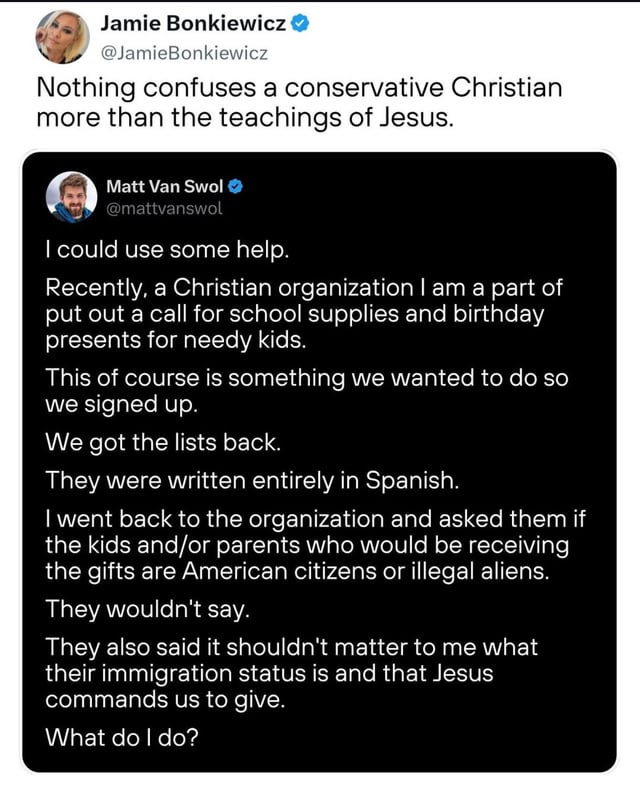
But the thing is they dont.
As religion has declined, the vast majority of people who used to go to church weekly haven’t replaced that by attending other community groups. And the “interest” part also fundamentally changes the nature of it. People going to church were often going there out of a sense of obligation. Parents don’t drag their kids to the comic shop and make them hang out with people.
Wall of text incoming.
What make claim this general statement ?
Yes, but what’s your point?
I don’t know enough about the sociology behind this. However, this sense of obligation can also apply to gatherings not related to any christian church. Peer pressure and other social norms are not reserved to religious groups from the christian family of religions, nor to any religious or ideological group.
Are you sure? I agree that not usual regarding a comic shop specically, but it still can happen. If not parents, other family members or friends can force someone into the forceful one’s favourite gathering evenet/place. The place can be a comic shop. I actually have been pressured by someone to participate to a very private cultural club regrouping a fraction of the community I talked about. That “someone” was a member of the club, but didn’t even ask other members consent before shoehorning me in. The club session didn’t take place in the shop, but in some members’ homes. Most accepted me, but still… others and I were forced to interact in this situations, and the only thing that helped is that we already interacted spontaneously and positively at several previous encounters.
Parents do indeed drag their kids to non religious social hubs and make them hang out with people :
Friends or relatives from the same generation can also do the same, to the same kind of hubs, plus others like nightclubs and their afterwork equivalent (that matches “events with friends or colleagues”, but the noise and the mass of people adds much stress for some.)
I’ve personnally experienced most of that when I was a child / teen, and still experience part of it. And although I was a roman catholic as a child, the only times this forced socialisation happened linked to church activities were linked to marriages, communions, baptism or funeral. I never took part in catechism, nor in periodic masses, or any parish event. That didn’t prevent me from finding a community. Actually, social norms and obligations were and still are one of the biggests obstacles preventing me from participating in significant way in a community. The others are social fears/anxiety, and poor mental health. (Due to working and living conditions degradation, as well as to the socio-ecological context, and the economics and politics that cause all of this. I hate the greed for any kind of domination, and the oppression and exploitation this greed encourages.)
Anyway, I don’t understand your point about the “obligation” incentive, and the forced participation. It wasn’t part of the discussions when I first answered, so it’s not a point I discussed either.
Communities and social interactions, wether linked to any religion or not, can and will happen without external constraints.
The absence of pressure is even better. Forced social interactions are at best awkward and tiring. I usually find these abusives. They also implies power dynamics that will probably lead to further suffering, toxicity, or (potentially very serious) abuses. We should not encourage the use of religion as a domination system (or any such system really) to force and structure social interactions and community.
That forced social obligation angle is an important if weird part of how churches benefit society in non-religious ways. People who only ever do what they want when they want end up in isolation bubbles.
As attendance at churches has plummeted while the remaining churches have politicized, people have replaced those communities on social media, which have algorithmically placed them in echo chambers.
And occasionally hanging out with friends is not participating in a third place like a church. They no longer regularly socialize with hundreds of community members they otherwise would never speak with. And that is a loss. It’s one reason people are increasingly lonely.
Inknow people who are stuck in dead-end careers and hate their lives whonreally should just move somewhere else, but they’re afraid to because they have like 5 people in the world they’re close to, and literally don’t knkw how they’d find a new socialmgroup if they moved across the country. The answer to that used to be to move to a new area, start attending church, and meet people.
You seem to misunderstand my two previous comments. Reread carefully, and don’t hesitate to ask for precisions or complementary explanations about what I said. Also remember that contrary to some people’s belief:
That’s not at all specific to churches, nor does it only produces beneficial consequences for society. (Domination systems pose many societal problems, some deadly.)
I don’t agree with that statement. That doesn’t match the acts of solidarity and socialisation I witnessed.
Or not. Offline social hubs, politicized or not, and old school online social hubs still exist. Aside frop those I cited before, bars / pubs / cafés are still social hubs. The workplace is one too, at least in places where workers can have purely personal interactions with their colleagues.
By the way, politisation is not inherently bad, and the politisation of churches is as old as churches. Charity is political, preaching is political, clergy is in a way a political organisation. Hell, countries like the USA or France have law separating the “State” from the “Church” precisely because of the history of political ingerence from religious organisations like the roman catholic Church or the anglican Church.
Which difference with a community of churchgoers ? The religious belief systems, combined to the rules dictated by the clergy and peer pressure, can also cause an echo chamber. Any kind of community can become an echo chamber. Predatory communication media on internet (including the so called “social networks” or “social media”) are indeed efficient at maintaining very-large-scale echo chambers that transcend geography.
Agreed, but I cited this only as an exemple of possible forced interactions. They can however lead to create or participate in what you call “a third place”.
Very probably false. Your statement is, once again, based on the assumption that church was and still is the sole purveyor of motivation to socialise, form communities, help each other, etc. That has never been true.
Irrelevant since the premise is false. I didn’t rigrously studied socilogy meta-studies on the subject, and you didn’t either considering how you phrase your statements, but I’m pretty sure the so called “loneliness epidemic” does not count the decrease in church attendance (or the secularisation of most christian dominated societies) as a significant cause. I’m sure these may share common causes, though.
You almost had it. The church part was only one possibility among athoers. For some people, avoiding any church at all costs was a solution.
Because contrary to how you portray churches and their communities, these are not paragons of happiness, fulfilment, or benefits to society. Some communities may be mostly beneficial, some mostly detrimental. On the whole a common aspect of religions is control : religions can be viewed as systems of belief or systems of social cohesion, sure, but they also can be viewed as systems of domination. You yourself mention that aspect when talking about the obligations.
Systems of domination are never beneficial to society. They are beneficial only to the few at the top of these systems. These are the main tool enabling all kind of abuses :
For oppressed groups, churches cannot be a solution if they and their church-affiliated communities are part of the oppressors. Are they condemned to be isolated though ? No. They can find a sense of community, belonging, support, solidarity, an contribute to benefit the society as a whole, and chruches are not to thank for that. Mostly, autosupport organisations are their main salvation. Can these be echo chambers ? Depending of the subject, of course, like any community. Can they suffer from social media ? Yup, because their oprresor are dominant there too, but autosupport groups can also exploit the less predatory ones to help extend their group, and thus their ability to support each other and defy oppression.
Tl;dr : even when talking about community, belonging, solidarity, benefical impact, etc, churches are not the center of the world, nor the main model. Churches can even be an obstacle.
90+% of people used to attend church weekly. What percentage of non-churchgoers (religious or not) have replaced that time with weekly attendance at other community gatherings?
Yes - many things can theoretically fill that void, but they don’t. For the most part, people aren’t replacing religious community involvement with non-religious community involvement. As church attendance has declined, people have largely stopped being involved in the community on a regular basis.
No. This number comes out of nowhere. Maybe 90+ % of churchgoers did, but that’s what a churchgoer is.
Or you talk about a time when this was mandatory for the population. Pretty sure that was never the case in the USA, whose constitution in incompatible with mandatory participation in religious office.
I have no interest in continuing this interaction, since you don’t seem to accept that communities always existed and thrived outside of religious duties and cult sites.
Bye.
Also : please re-read this lemmy community rules, as I just did, because you pushing the idea that only church have meaningful communities is not really compatible with the claimed goals of this community. (Me engaging in a debate with you seeam to also break a rule. Sorry fellow atheists and apostates.)