

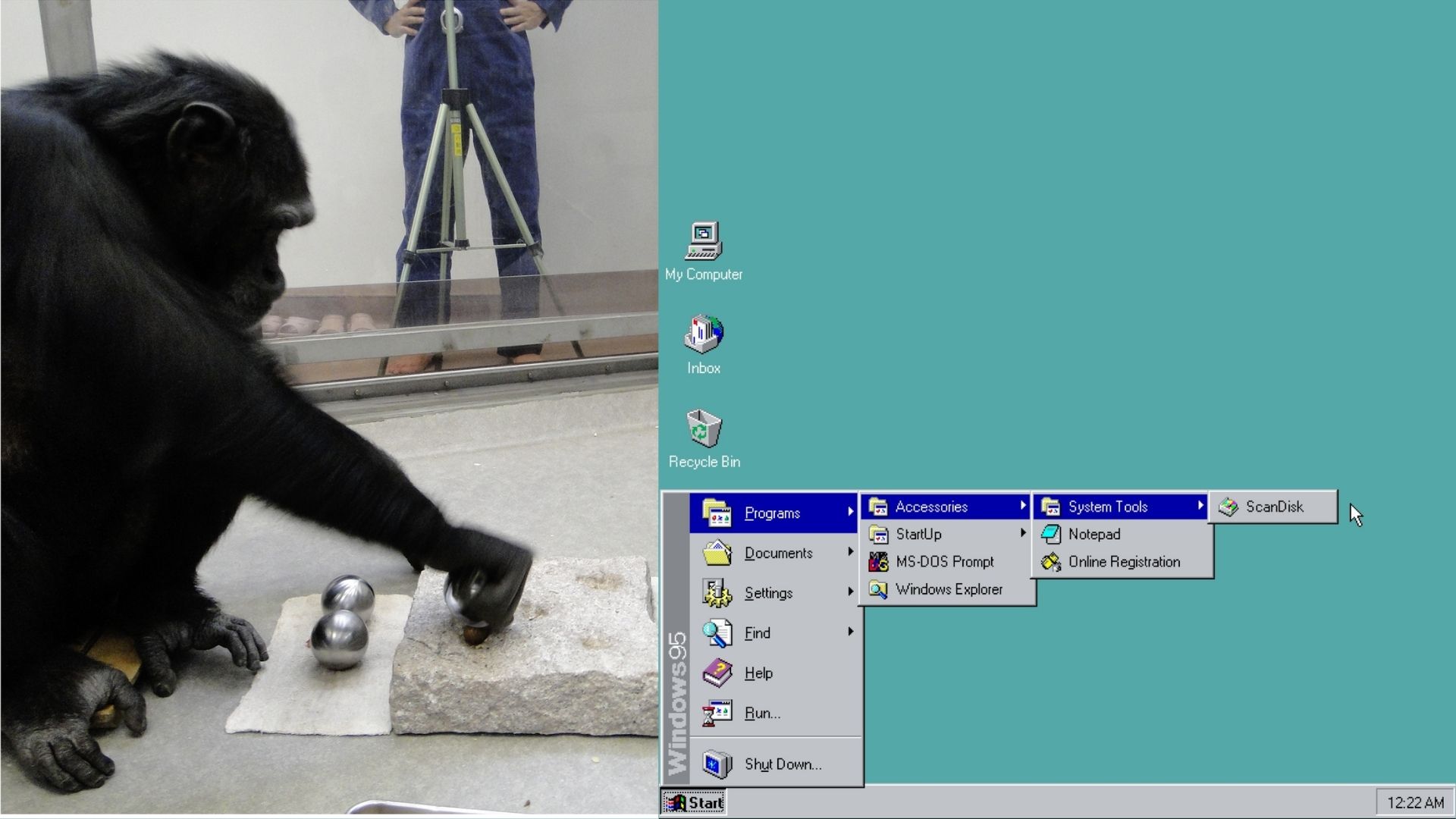
Former Microsoft exec explain how a behavioral psychologist utilized Fitts’s law to place the Windows 95 Start button in the bottom-left.
Former Microsoft exec explain how a behavioral psychologist utilized Fitts’s law to place the Windows 95 Start button in the bottom-left.
This smells apocryphal to me. Very apocryphal.
Like you don’t need a behavioral psychologist to explain why people are going to prefer putting menunthingies out of the way.
Even back before a mouse, graphical applications (like q-basic) would place their menuthingies at the top, in a header. They had already established a pattern we still largely follow today- the most general menu category goes to the right, the most specific to the left.-
File is stuff relating to the document- opening, closing, savoring; document wide settings, etc, where help is… uh… extremely specific and almost never used.
So you already have this pattern in UC design; applications are already following it because it makes sense. So now, your devs need to place another menu bar somewhere, and they place it at the bottom, so it’d out of the way of everything else, and they follow the pattern.
oh. and NeXTSTEP’s came out in '88…
I wouldn’t be so sure. Fitts’s law is well-known and could easily have been in the right state for this story to be true at the time. I remember learning specifically about how it applies to the corners of ths screen in a Human-Computer Interaction class once.
And the apple menu was already in the top left before windows 95.
I remember working with a friend and his dad to build a large shed. Because my geometry, trig, and calculus teachers were always drilling into me how eminently PRACTICAL these maths were, I thought all my training would come in handy, but every time I sat down to do a calculation, my friend and his dad would just arrange a few boards a certain way, mark one of them, and be on their way, their problem solved perfectly within their required tolerance.
Abstract thinking is often more trouble than its worth.
Aligning boards like that is kind of a form of abstract thinking. Less than using math though of course.
Agree with everything, except one thing: qbasic had a text-based user interface, and also you could use a mouse within it if you had a dos mouse driver.
The qbasic version we had was graphical in the sense of not being in dos like how nano works in the terminal today, but was not graphical in the sense of a mouse clicking things.
Granted I was like eight? So I could be miss remembering. Pretty sure the only interest I had was the gorilla game where you were chucking exploding bananas at each other.
The interface was fancier than nano’s, but still text. It didn’t draw pixels but only text characters, so it falls under text-based user interface (TUI). And also you could use a mouse to go clicking things, if you had a DOS mouse driver. The ‘pointer’, being it a TUI, was just the same character with inverted colours.
If you feel nostalgic there exists qb64. It’s almost identical to the original qbasic, with some added modern things, available for win, Mac, and Linux and compiled (transpiled) instead of interpreted, and it can run gorillas.bas!