Separation of church and state is different from separation of state and religious laymen. The majority of the population are religious so excluding them would be worse democratically than excluding women. What’s actually meant by separation of church and state is that people working in the church (priests, Bishops, popes) shouldn’t meddle with the running of the state. Nothing to do with religious laymen.
If a religious layman is motivated by his religion to make policies that you don’t agree with you should not vote for that person. If anyone else agrees with his religiously motivated policies then they should be allowed to vote for that person. I don’t think this is too crazy of a concept. Now if that specific religiously motivated policy happens to be unconstitutional that is a totally different matter.
Is religious persecution and pogroms allowed in the constitution? Also systematically disallowing religious people from office is a form of religious persecution.
Mmmm, no that’s what the First Amendment is partially for. The government shall pass no law respecting the establishment of religion or prohibiting the free exercise thereof. I have a right to be a Satanist in peace without yokels shoving their way of life down my throat
If a lawmaker bans satanism or enacts a law that otherwise discriminates against satanists. Then that’s not allowed. But what wouldn’t be a problem would be a religious lawmaker on a totally secular subject. Like the example I gave in another comment how one could in theory loosen immigration restriction by quoting the parable of the good Samaritan. That law would not be religious law, even if the law maker was motivated by his religious belief.
It’s not too crazy of a concept but is absolutely not what separation of church and state means. It’s crazy that you think this is what it means.
You can’t have the majority forcing their religion onto the minority. That’s the exact reason we have separation of church and state. To protect the people who will never win an election.
Separation of church and state is different from separation of state and religious laymen.
Fucking lies!. And it’s a bald faced lie that results in “In God We Trust” on our money.
There is either a separation or there is not. There is no in between. It is binary and that’s the end of it. Anyone who attempts to negotiate an in-between is a FUCKING LIAR
E PLURIBUS UNUM
And if you have a problem with that, then you have a problem with democracy
It’s not a lie. That’s how the very inventor of the term “separation of church and state” defined it and how it has been used for hundreds of years after. Roger Williams, who first used the term, was a puritan, later baptist, pastor. What you’re describing would be an innovation and expansion of what separation of church and state means. It seems what you really want is a separation between religion and state. That is a totally different issue. In the future it would be advantageous for you to be clear on that and explicitly say that it’s religion, not just church, that you want to exclude from the state.
I’m curious though. Which people would you want to exclude from the government. Church goers are obvious. But what about the “spiritual but not religious” people? Or people who believe in ghosts but not god? What about natives who believe their native religions? The non god believing buddhist? Who would define if someone is religious enough to be disallowed from running for office? Whoever that person was, that person would get immense power.
I’m fine with you insulting me. However I’m still interested to learn where you would draw the line between the non religious and the religious in your proposed ban of religious people in political office.
If I’m fine with having religious laymen in government and you’re also fine with having religious laymen in government then I’m not sure on what we disagree.
Just stop, no one is interested in your garbage laymen bullshit.
NO RELIGIOUS LAWS OR TEXTS IN THE LAWS, THEY NEED TO STAY SECULAR BECAUSE THERE IS MORE THAN ONE RELIGION AND WE WANT TO RESPECT THEM ALL.
If we start using christian laymen religious texts in laws then we will need all other religions texts right next to the christian ones so that it is fair to the other beliefs.
Is that what you want?
Is that how laws should be made?
How about just cutting religion out of the equation all together and making the text of law about the law and not about you?
I have no problem with people having religious beliefs…in private. But, as far as I’m concerned, as soon as those religious beliefs start dictating your policy priorities…you have lost your ability to make objective decisions on behalf of the rest of us. That goes equally for “laymen” as well as “professionals”.
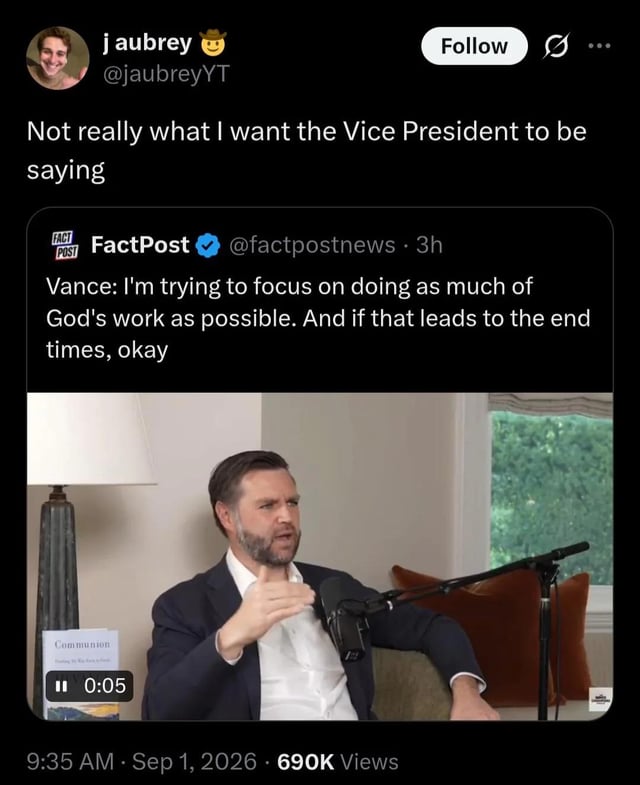
This case is a perfect example. Anyone openly saying that they’re just going to “follow their faith”, even if it leads us all to total destruction, needs to be removed from office. Yesterday. I wouldn’t even trust that person to drive a city bus, let alone guide policy for the entire population.
I agree that if a religious laymen uses religion to make bad policies then he shouldn’t be in office. However democracy is supposed to represent the people and if the people want to elect a religious nutjob then that’s a failure of the people, not the democratic system. You can’t make a law that says religious people can’t run for office as that would be extremely undemocratic and go against religious freedom.
You can’t make a law that says religious people can’t run for office…but you can make a law that says they can’t make policy based on their religious beliefs.
That’s what the 1st amendment is supposed to prevent.
I’m not American so correct me if I’m wrong. But wasn’t the first amendment about disallowing the government from establishing or favoring a specific religious establishment. Meaning it would be illegal to say make a law that favors or teaches baptism in school at the expense of another Christian flavor. What I understand of the history behind freedom of religion in the US was that people were sick of the UK mandating the very specific theology of the Anglican church and instead wanting a system where people were allowed to practice any flavor of Christianity that they wanted. From this it would be no problem being a religious person in office but it would not be okay for that person to give benefits or favor to their specific church while in office.
Not making policy based on religious belief would be impossible however. One’s religion would impact one’s entire morality and value system. So one could say we should enact policy X because the bible says so. But one couldn’t say we should enact policy X because the southern baptist Convention just made a ruling that policy X should be enacted and now we have to make a law that matches that ruling.
Congress shall make no law respecting an establishment of religion, or prohibiting the free exercise thereof
It is as you said…primarily as a freedom to practice whatever religion you want…but this also effectively prohibits any government official from enacting any policy or legislation that promotes their own religious beliefs over any other, since it may conflict with the free practice of someone else’s religion.
In essence, it prevents the state from getting involved in religious matters altogether.
But I could in theory promote a secular policy based on my theoretical religious belief. Say I want to lower barriers to immigration and as motivation I quote the parable of the good Samaritan saying that even foreigners should be treated as ones neighbour. Now in doing this I’m letting my religious belief affect my policy making. However I’m not inhibiting anyone else’s free practice of religion since this is secular policy.
Yup. That’s all very true. But, when some idiot politician like JD here, straight up says the quiet part out loud, you can sue the government for all kinds of wrongful damages. Now, all of his policy positions can justifiably be scrutinized through this lens.
As for inhibiting anyone else’s free practice…that’s where the first amendment is most powerful. I have the right to not be governed by someone else’s religious beliefs. So, when JD here straight up admits that he’s governing based on his religious beliefs…that automatically means he’s infringing upon everyone else’s.
prohibits any government official from enacting any policy or legislation that promotes their own religious beliefs over any other, since it may conflict with the free practice of someone else’s religion.
Okay, so Christianity says we can’t kill people. But jihadism exists in Islam. Then the law must allow killing by Islamists to avoid being based on Christian beliefs and restricting jihadists’ practice?
Not exactly. Secular law supercedes religious law…and that is based on the concept of measurable harm. This is the concept that you cannot inflict measurable harm on another person against their will, without running afoul of the law in some way…whether it be a criminal or a civil violation.
However, there have been plenty of cases in the US where religious folks have argued…sometimes successfully…that their religious beliefs grant them an exception to secular law. But, unless local laws already make allowances for it, those cases always require a trial to determine whether that exception should be granted. And they are rare.
Secular law supercedes religious law…and that is based on the concept of measurable harm. This is the concept that you cannot inflict measurable harm on another person against their will
That’s a bold claim that it’s based on that concept, when there were and are plenty of laws that caused harm, and some of them are conspicuously based on Christian norms.
For example, both federal and twenty-six states’ law prohibit cannabis for recreational use while allowing alcohol. Some states prohibit abortion even in the case of danger to the mother. How was that harm measured?
Besides, why do you think that religious laws aren’t based on a belief in their moral utilitarianism? Just like modern laws don’t work on purely libertarian terms where one can’t limit another in any way except for self-defense, religious prescriptions also followed a perceived common good.
The original comment said: " How can you trust someone to run the country, when all their decisions are grounded in magical thinking?"
This in regards to the need to have a separation of church and state on a post about JD Vance being religiously motivated in the decisions he’s making. I interpret this as the person seeing the existence of JD Vance as a failure of “separation of church and state” and that this separation needs to become stronger. However JD Vance is not part of the clergy. He’s simply a religious layman. No church is running this government and therefore the current separation of church and state doesn’t apply.
So then my question to you is, how would you by law prevent another JD Vance from being elected, for the explicit reason that he uses religion to make decisions, without banning religious people from political office ?
I can’t find a good solution to this without making thought crime a thing. A religious person would be unable to see certain issues without some kind of perspective from their religion.
Holy fuck do you think separation of church and state only means that we can’t have the equivalent of the Holy Roman Emperor? Like
You actually think the first amendment is about stopping the church from running the government?
The down votes on this are insane to me. He just gave the original definition of the separation of church and state.
Every elected representative should only be bound by existing laws and their own conscience. That means that if someone chooses to listen to sky daddy or the flying spaghetti monster while in elected office, that’s up to them. It sucks, but you can’t have a democracy in which you tell people what the basis for their decisions must be. If the people elect an Astrologer to office that person should be free to base their decisions on the movement of Jupiter through Sagittarius or whatever.
Democracy is designed to empower the statistical average will of the people. Not produce “best” (by whatever measure) outcomes for the country. Just what people want.
No. Democracy is definitionally “Vote what you want to vote for.”
Ideally people vote for what they think is best for the country/the world/your peers.
But part of democracy (and a rather important part) is that NOBODY GETS TO TELL ANYBODY WHAT TO VOTE FOR AND WHY (within the legal confines of what allowed political expression is). So yes. A lot of people vote for what they think will be best for them. And people often make fun of people that vote for things that will be bad for them (see the whole leopards eating faces meme culture).
So “voting to benefit one self” can not be a crazy concept to you…
Of course. But I’m obviously not talking about advertisement or debate. I’m talking about coercing votes or decisions. I figure that’s pretty obvious from context.
Which makes a lot of sense when you remember a lot of the North American population hailed from families who had a specific beef with a specific church and state; the role of bishops was one of these many axis of opposition during the conflict in Britain and Ireland.
The English Civil War and its aftermath is barely taught on either side of the Atlantic, yet it’s so important to understanding both countries’ history. The per capita casualty rate was worse than WW1, no wonder people felt rather strongly about religion and in some cases still do


Separation of church and state is different from separation of state and religious laymen. The majority of the population are religious so excluding them would be worse democratically than excluding women. What’s actually meant by separation of church and state is that people working in the church (priests, Bishops, popes) shouldn’t meddle with the running of the state. Nothing to do with religious laymen.
Are you saying it’s fine for elected religious laymen to force religion into our government and onto its people because they’re not church officials?
If a religious layman is motivated by his religion to make policies that you don’t agree with you should not vote for that person. If anyone else agrees with his religiously motivated policies then they should be allowed to vote for that person. I don’t think this is too crazy of a concept. Now if that specific religiously motivated policy happens to be unconstitutional that is a totally different matter.
This is how you end up with religious persecution and pogroms.
This is how you end with child rapism being legal in islamic countries, or how you get anti-queer and anti-atheist policies in most places.
Is religious persecution and pogroms allowed in the constitution? Also systematically disallowing religious people from office is a form of religious persecution.
Your “contitution” isn’t worth the paper it’s written on.
Go read a history book.
https://www.au.org/wp-content/uploads/2023/04/what-god-has-put-asunder.pdf
Read this, its from James Madison(he was one of your founding fathers).
Also:
https://www.au.org/wp-content/uploads/2023/04/madisons-memorial.pdf
And from Thomas Jefferson:
https://www.au.org/wp-content/uploads/2023/04/with-sovereign-reverence.pdf
Mmmm, no that’s what the First Amendment is partially for. The government shall pass no law respecting the establishment of religion or prohibiting the free exercise thereof. I have a right to be a Satanist in peace without yokels shoving their way of life down my throat
If a lawmaker bans satanism or enacts a law that otherwise discriminates against satanists. Then that’s not allowed. But what wouldn’t be a problem would be a religious lawmaker on a totally secular subject. Like the example I gave in another comment how one could in theory loosen immigration restriction by quoting the parable of the good Samaritan. That law would not be religious law, even if the law maker was motivated by his religious belief.
It’s not too crazy of a concept but is absolutely not what separation of church and state means. It’s crazy that you think this is what it means.
You can’t have the majority forcing their religion onto the minority. That’s the exact reason we have separation of church and state. To protect the people who will never win an election.
FUCKING LIES!
Fucking lies!. And it’s a bald faced lie that results in “In God We Trust” on our money.
There is either a separation or there is not. There is no in between. It is binary and that’s the end of it. Anyone who attempts to negotiate an in-between is a FUCKING LIAR
E PLURIBUS UNUM
And if you have a problem with that, then you have a problem with democracy
*E Pluribus Unum
And I agree, LIES!! But christians are hypocrites.
Am I understanding you correct that you think no person with religious beliefs should be allowed to hold office?
As long as none of the pluribus hold any religious belief?
No
Do you want to help me understand you or are you just trolling?
Also no
You feing learning so you can keep proselytizing; you are the troll you accuse others of being.
It’s not a lie. That’s how the very inventor of the term “separation of church and state” defined it and how it has been used for hundreds of years after. Roger Williams, who first used the term, was a puritan, later baptist, pastor. What you’re describing would be an innovation and expansion of what separation of church and state means. It seems what you really want is a separation between religion and state. That is a totally different issue. In the future it would be advantageous for you to be clear on that and explicitly say that it’s religion, not just church, that you want to exclude from the state.
I’m curious though. Which people would you want to exclude from the government. Church goers are obvious. But what about the “spiritual but not religious” people? Or people who believe in ghosts but not god? What about natives who believe their native religions? The non god believing buddhist? Who would define if someone is religious enough to be disallowed from running for office? Whoever that person was, that person would get immense power.
lol, nice try, fuck bag. That bullshit doesn’t work here anymore.
I’m fine with you insulting me. However I’m still interested to learn where you would draw the line between the non religious and the religious in your proposed ban of religious people in political office.
Noone advocated for banning religious people. We want to prevent religious policy
If I’m fine with having religious laymen in government and you’re also fine with having religious laymen in government then I’m not sure on what we disagree.
Just stop, no one is interested in your garbage laymen bullshit.
NO RELIGIOUS LAWS OR TEXTS IN THE LAWS, THEY NEED TO STAY SECULAR BECAUSE THERE IS MORE THAN ONE RELIGION AND WE WANT TO RESPECT THEM ALL.
If we start using christian laymen religious texts in laws then we will need all other religions texts right next to the christian ones so that it is fair to the other beliefs.
Is that what you want?
Is that how laws should be made?
How about just cutting religion out of the equation all together and making the text of law about the law and not about you?
Simple definition: anyone that believes in anything not falsable, nor empirically and scientifically demonstrable.
I have no problem with people having religious beliefs…in private. But, as far as I’m concerned, as soon as those religious beliefs start dictating your policy priorities…you have lost your ability to make objective decisions on behalf of the rest of us. That goes equally for “laymen” as well as “professionals”.
This case is a perfect example. Anyone openly saying that they’re just going to “follow their faith”, even if it leads us all to total destruction, needs to be removed from office. Yesterday. I wouldn’t even trust that person to drive a city bus, let alone guide policy for the entire population.
I don’t trust those who prefers afterlife to rule my life
I agree that if a religious laymen uses religion to make bad policies then he shouldn’t be in office. However democracy is supposed to represent the people and if the people want to elect a religious nutjob then that’s a failure of the people, not the democratic system. You can’t make a law that says religious people can’t run for office as that would be extremely undemocratic and go against religious freedom.
You can’t make a law that says religious people can’t run for office…but you can make a law that says they can’t make policy based on their religious beliefs.
That’s what the 1st amendment is supposed to prevent.
I’m not American so correct me if I’m wrong. But wasn’t the first amendment about disallowing the government from establishing or favoring a specific religious establishment. Meaning it would be illegal to say make a law that favors or teaches baptism in school at the expense of another Christian flavor. What I understand of the history behind freedom of religion in the US was that people were sick of the UK mandating the very specific theology of the Anglican church and instead wanting a system where people were allowed to practice any flavor of Christianity that they wanted. From this it would be no problem being a religious person in office but it would not be okay for that person to give benefits or favor to their specific church while in office.
Not making policy based on religious belief would be impossible however. One’s religion would impact one’s entire morality and value system. So one could say we should enact policy X because the bible says so. But one couldn’t say we should enact policy X because the southern baptist Convention just made a ruling that policy X should be enacted and now we have to make a law that matches that ruling.
It is as you said…primarily as a freedom to practice whatever religion you want…but this also effectively prohibits any government official from enacting any policy or legislation that promotes their own religious beliefs over any other, since it may conflict with the free practice of someone else’s religion.
In essence, it prevents the state from getting involved in religious matters altogether.
But I could in theory promote a secular policy based on my theoretical religious belief. Say I want to lower barriers to immigration and as motivation I quote the parable of the good Samaritan saying that even foreigners should be treated as ones neighbour. Now in doing this I’m letting my religious belief affect my policy making. However I’m not inhibiting anyone else’s free practice of religion since this is secular policy.
Yup. That’s all very true. But, when some idiot politician like JD here, straight up says the quiet part out loud, you can sue the government for all kinds of wrongful damages. Now, all of his policy positions can justifiably be scrutinized through this lens.
As for inhibiting anyone else’s free practice…that’s where the first amendment is most powerful. I have the right to not be governed by someone else’s religious beliefs. So, when JD here straight up admits that he’s governing based on his religious beliefs…that automatically means he’s infringing upon everyone else’s.
Keep your stories out of secular law please. We will enact no law that favors religion(or uses any part of it).
Okay, so Christianity says we can’t kill people. But jihadism exists in Islam. Then the law must allow killing by Islamists to avoid being based on Christian beliefs and restricting jihadists’ practice?
Not exactly. Secular law supercedes religious law…and that is based on the concept of measurable harm. This is the concept that you cannot inflict measurable harm on another person against their will, without running afoul of the law in some way…whether it be a criminal or a civil violation.
However, there have been plenty of cases in the US where religious folks have argued…sometimes successfully…that their religious beliefs grant them an exception to secular law. But, unless local laws already make allowances for it, those cases always require a trial to determine whether that exception should be granted. And they are rare.
That’s a bold claim that it’s based on that concept, when there were and are plenty of laws that caused harm, and some of them are conspicuously based on Christian norms.
For example, both federal and twenty-six states’ law prohibit cannabis for recreational use while allowing alcohol. Some states prohibit abortion even in the case of danger to the mother. How was that harm measured?
Besides, why do you think that religious laws aren’t based on a belief in their moral utilitarianism? Just like modern laws don’t work on purely libertarian terms where one can’t limit another in any way except for self-defense, religious prescriptions also followed a perceived common good.
Wtf… You have -∞ IQ.
What they mean is that neither Christian-based nor Islamic-based (and in general religious-based) laws shouldn’t be passed.
Man either you’re trolling (propaganda spreading) or you’re so dense it’s worthless to try to explain anything to you.
Separation of church and state isn’t that hard a concept. Even a child can understand it.
But u: sHoUlD wE BAN rEligious pEoPle??!!!
Common grow up, it’s actually a cool place here if you do want to discuss.
The original comment said: " How can you trust someone to run the country, when all their decisions are grounded in magical thinking?"
This in regards to the need to have a separation of church and state on a post about JD Vance being religiously motivated in the decisions he’s making. I interpret this as the person seeing the existence of JD Vance as a failure of “separation of church and state” and that this separation needs to become stronger. However JD Vance is not part of the clergy. He’s simply a religious layman. No church is running this government and therefore the current separation of church and state doesn’t apply.
So then my question to you is, how would you by law prevent another JD Vance from being elected, for the explicit reason that he uses religion to make decisions, without banning religious people from political office ?
I can’t find a good solution to this without making thought crime a thing. A religious person would be unable to see certain issues without some kind of perspective from their religion.
Holy fuck do you think separation of church and state only means that we can’t have the equivalent of the Holy Roman Emperor? Like You actually think the first amendment is about stopping the church from running the government?
That’s not democracy, that’s demagogy and ochlocracy.
I see what you’re saying. You can’t exclude everyone from every religion from running for office.
Are you sure? I think maybe we should try that and see how it goes.
The down votes on this are insane to me. He just gave the original definition of the separation of church and state.
Every elected representative should only be bound by existing laws and their own conscience. That means that if someone chooses to listen to sky daddy or the flying spaghetti monster while in elected office, that’s up to them. It sucks, but you can’t have a democracy in which you tell people what the basis for their decisions must be. If the people elect an Astrologer to office that person should be free to base their decisions on the movement of Jupiter through Sagittarius or whatever.
Democracy is designed to empower the statistical average will of the people. Not produce “best” (by whatever measure) outcomes for the country. Just what people want.
Wow you think That is what democracy is?
Like vote to benefit yourself? It explains the state of some places in the world rn but that’s wild if you come from a democratic country.
No. Democracy is definitionally “Vote what you want to vote for.”
Ideally people vote for what they think is best for the country/the world/your peers.
But part of democracy (and a rather important part) is that NOBODY GETS TO TELL ANYBODY WHAT TO VOTE FOR AND WHY (within the legal confines of what allowed political expression is). So yes. A lot of people vote for what they think will be best for them. And people often make fun of people that vote for things that will be bad for them (see the whole leopards eating faces meme culture).
So “voting to benefit one self” can not be a crazy concept to you…
All advertising for elections are about this:
Of course. But I’m obviously not talking about advertisement or debate. I’m talking about coercing votes or decisions. I figure that’s pretty obvious from context.
Okay sure one part is you get to vote on who/which party you want, but that wasn’t what I was arguing about.
vote is not to get what you want, it is to kick out the bad person, replace them.
getting active in politics is what you do to actually change something.
Both these are subdued or erased in dictatorships, but not in functional democracies.
Which makes a lot of sense when you remember a lot of the North American population hailed from families who had a specific beef with a specific church and state; the role of bishops was one of these many axis of opposition during the conflict in Britain and Ireland.
The English Civil War and its aftermath is barely taught on either side of the Atlantic, yet it’s so important to understanding both countries’ history. The per capita casualty rate was worse than WW1, no wonder people felt rather strongly about religion and in some cases still do