I don’t know if I’ve told this joke in this community before, but here goes. A man is driving through Northern Ireland at the height of the Troubles. He comes across a fallen tree and stops. Before he knows what’s happening, men in balaclavas and with automatic rifles are shouting at him and banging on the window of his car.
“Are you a catholic or a protestant?” One of the masked men asks. The man in the car, knows the wrong answer could get him shot.
“I’m an atheist.” Says the man.
“Are you catholic atheist or a protestant atheist?” Shouts the masked man.
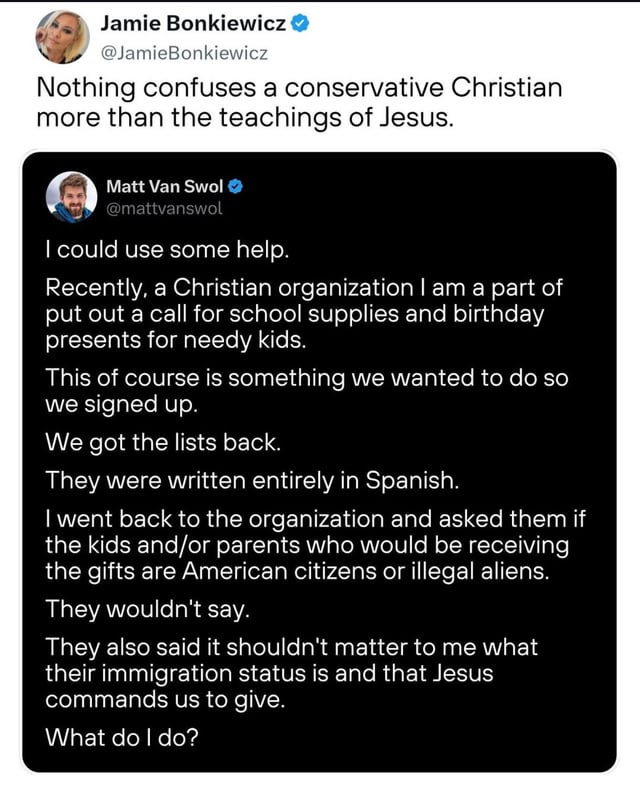
I strongly suspect a lot of American Christians aren’t particularly religious. Instead they’re using religious affiliation, and Christian symbols, as signifiers of an ethnic/sectarian identity. That’s why the man in the post above, doesn’t care about non-white Christians, doesn’t care about what the bible says he should do, and likely doesn’t care that his leaders are often immoral people who regularly commit blasphemy and heresy. For him being a Christian means belonging to a white protestant American ethnic group, that God is on their side, and not much more.
It’s fundamentally not that different to Ratko Mladić, who had previously been a longstanding and reputable member of the communist party, and who people said wasn’t religious, claiming he was defending Christianity against Islam when he became the Butcher of Bosnia. Or Putin, the former KGB operative, claiming he’s defending Christian values against Western decadence in Ukraine.
Church is by far the biggest third place. It’s Christian Club where people hang out with other community members a couple hours a week, and in a healthy Church it can result in very powerful, positive, and effective community building. You can have millionaires and grocery bangers treating each other as equals prepping for a BBQ or singing in the choir.
The religion itself often ends up being quietly secondary to the community building, and I still don’t know what replaces the Church for the non-religious. I’ve been to gatherings of like-minded people that weren’t Church, but the regularity and diversity of people in a healthy Church (regardless of the specific faith) is something I haven’t seen elsewhere, and I do think it’s something that can be good for society.
I knew the CEO of a pretty big corporation who was in Sunday School classes with ex-cons and burger flippers, and that experience made them all see each other in a different light that was good for everyone. It taught the poor and the powerful that they were all just people. It made the powerless more willing to stand up to their “betters” and the powerful more empathetic to people who weren’t as fortunate.
Yeah as an outsider, the big welcoming social club aspect of religion is a big appeal.
I wonder if part of the reason it works when regular social clubs often don’t is because of the “obligatory attendance” part. A lot of people have some great memories of school for instance, which is another place where all the attendees are obligated to attend even though the actual events that are hosted there are often boring as fuck. Maybe there’s some kind of camaderie due to that, “We’re all stuck here together with him/her” *gestures up at the teacher/pastor*
While at an actual social club, the socializing itself is the main reason for being there, and that means socializing can easily become a chore, rather than an escape.
The religion itself often ends up being quietly secondary to the community building, and I still don’t know what replaces the Church for the non-religious.
What can act as community hubs are very dependant of the community, but really don’t need to relate to religion. Especially if they serve as hub for people from different religious backgrounds
Aside from the places linked to religious activity, from any religion, the places that come to my mind, partly from my own experience, are:
Local dedicated community centers, where they exist.
Associations & clubs (the sport of school kind, not gentlemen’s clubs)
Sometimes shops.
The best community hub I used to go to was actually a “booksshop” dealing in mangas, anime, video games, and tabletop games. They often organised nocturnal tabletop gaming events. The shop served as a social hub even outside of these events, and the community was a safe place for some us not “misfits” (special interest nerds, LGBTQIA+ teens and adults, etc).
In other words, any community driven or community focused place or organisation can serve as a meaningful cosmopolitan social hub. People will gravitate naturally toward the hub·s centered around their interests. (Be it a religion, a sport, a social cause, a subculture, etc.)
As religion has declined, the vast majority of people who used to go to church weekly haven’t replaced that by attending other community groups. And the “interest” part also fundamentally changes the nature of it. People going to church were often going there out of a sense of obligation. Parents don’t drag their kids to the comic shop and make them hang out with people.
As religion has declined, the vast majority of people who used to go to church weekly haven’t replaced that by attending other community groups.
religion != going to christian a church or temple
even practicing christians can have their own way of practicing
non-religious people and secular social gatherings are much older than christian churches, and far more than any US church
how can can you even claim “the vast majority of people who used to go to church weekly haven’t replaced that by attending other community groups” ?
And the “interest” part also fundamentally changes the nature of it.
Yes, but what’s your point?
People going to church were often going there out of a sense of obligation.
I don’t know enough about the sociology behind this.
However, this sense of obligation can also apply to gatherings not related to any christian church. Peer pressure and other social norms are not reserved to religious groups from the christian family of religions, nor to any religious or ideological group.
Parents don’t drag their kids to the comic shop and make them hang out with people.
Are you sure? I agree that not usual regarding a comic shop specically, but it still can happen. If not parents, other family members or friends can force someone into the forceful one’s favourite gathering evenet/place. The place can be a comic shop. I actually have been pressured by someone to participate to a very private cultural club regrouping a fraction of the community I talked about. That “someone” was a member of the club, but didn’t even ask other members consent before shoehorning me in. The club session didn’t take place in the shop, but in some members’ homes. Most accepted me, but still… others and I were forced to interact in this situations, and the only thing that helped is that we already interacted spontaneously and positively at several previous encounters.
Parents do indeed drag their kids to non religious social hubs and make them hang out with people :
family events
village / town events
events with friends or colleagues
public or private ceremonies (marriages, veteran ceremonies, etc)
public events (fireworks, ball, promotional events, anything really)
sports, cultural, or other clubs, even when none of the parents is a member of the club
rallyes (the aristocrat networking event, not the vehicle race.)
Friends or relatives from the same generation can also do the same, to the same kind of hubs, plus others like nightclubs and their afterwork equivalent (that matches “events with friends or colleagues”, but the noise and the mass of people adds much stress for some.)
I’ve personnally experienced most of that when I was a child / teen, and still experience part of it. And although I was a roman catholic as a child, the only times this forced socialisation happened linked to church activities were linked to marriages, communions, baptism or funeral. I never took part in catechism, nor in periodic masses, or any parish event. That didn’t prevent me from finding a community. Actually, social norms and obligations were and still are one of the biggests obstacles preventing me from participating in significant way in a community. The others are social fears/anxiety, and poor mental health. (Due to working and living conditions degradation, as well as to the socio-ecological context, and the economics and politics that cause all of this. I hate the greed for any kind of domination, and the oppression and exploitation this greed encourages.)
Anyway, I don’t understand your point about the “obligation” incentive, and the forced participation. It wasn’t part of the discussions when I first answered, so it’s not a point I discussed either.
Communities and social interactions, wether linked to any religion or not, can and will happen without external constraints.
The absence of pressure is even better. Forced social interactions are at best awkward and tiring. I usually find these abusives. They also implies power dynamics that will probably lead to further suffering, toxicity, or (potentially very serious) abuses. We should not encourage the use of religion as a domination system (or any such system really) to force and structure social interactions and community.
That forced social obligation angle is an important if weird part of how churches benefit society in non-religious ways. People who only ever do what they want when they want end up in isolation bubbles.
As attendance at churches has plummeted while the remaining churches have politicized, people have replaced those communities on social media, which have algorithmically placed them in echo chambers.
And occasionally hanging out with friends is not participating in a third place like a church. They no longer regularly socialize with hundreds of community members they otherwise would never speak with. And that is a loss. It’s one reason people are increasingly lonely.
Inknow people who are stuck in dead-end careers and hate their lives whonreally should just move somewhere else, but they’re afraid to because they have like 5 people in the world they’re close to, and literally don’t knkw how they’d find a new socialmgroup if they moved across the country. The answer to that used to be to move to a new area, start attending church, and meet people.
You seem to misunderstand my two previous comments. Reread carefully, and don’t hesitate to ask for precisions or complementary explanations about what I said.
Also remember that contrary to some people’s belief:
atheism is not a recent thing
secular communities that can influence a whole society have not waited the 20th or 21th century either
christian churches didn’t exist before the 1st century. The world without it was not a hellhole without any community, solidarity, or any beneficial value.
christians churches are a model only to people whose personal culture was heavily influenced by any christian culture. Other social and cultural systems have other models.
That forced social obligation angle is an important if weird part of how churches benefit society in non-religious ways.
That’s not at all specific to churches, nor does it only produces beneficial consequences for society. (Domination systems pose many societal problems, some deadly.)
People who only ever do what they want when they want end up in isolation bubbles.
I don’t agree with that statement. That doesn’t match the acts of solidarity and socialisation I witnessed.
As attendance at churches has plummeted while the remaining churches have politicized, people have replaced those communities on social media,
Or not. Offline social hubs, politicized or not, and old school online social hubs still exist. Aside frop those I cited before, bars / pubs / cafés are still social hubs. The workplace is one too, at least in places where workers can have purely personal interactions with their colleagues.
By the way, politisation is not inherently bad, and the politisation of churches is as old as churches. Charity is political, preaching is political, clergy is in a way a political organisation. Hell, countries like the USA or France have law separating the “State” from the “Church” precisely because of the history of political ingerence from religious organisations like the roman catholic Church or the anglican Church.
which have algorithmically placed them in echo chambers.
Which difference with a community of churchgoers ? The religious belief systems, combined to the rules dictated by the clergy and peer pressure, can also cause an echo chamber. Any kind of community can become an echo chamber. Predatory communication media on internet (including the so called “social networks” or “social media”) are indeed efficient at maintaining very-large-scale echo chambers that transcend geography.
And occasionally hanging out with friends is not participating in a third place like a church.
Agreed, but I cited this only as an exemple of possible forced interactions. They can however lead to create or participate in what you call “a third place”.
They no longer regularly socialize with hundreds of community members they otherwise would never speak with.
Very probably false. Your statement is, once again, based on the assumption that church was and still is the sole purveyor of motivation to socialise, form communities, help each other, etc. That has never been true.
And that is a loss. It’s one reason people are increasingly lonely.
Irrelevant since the premise is false. I didn’t rigrously studied socilogy meta-studies on the subject, and you didn’t either considering how you phrase your statements, but I’m pretty sure the so called “loneliness epidemic” does not count the decrease in church attendance (or the secularisation of most christian dominated societies) as a significant cause. I’m sure these may share common causes, though.
Inknow people who are stuck in dead-end careers and hate their lives whonreally should just move somewhere else, but they’re afraid to because they have like 5 people in the world they’re close to, and literally don’t knkw how they’d find a new socialmgroup if they moved across the country. The answer to that used to be to move to a new area, start attending church, and meet people.
You almost had it. The church part was only one possibility among athoers. For some people, avoiding any church at all costs was a solution.
Because contrary to how you portray churches and their communities, these are not paragons of happiness, fulfilment, or benefits to society. Some communities may be mostly beneficial, some mostly detrimental. On the whole a common aspect of religions is control : religions can be viewed as systems of belief or systems of social cohesion, sure, but they also can be viewed as systems of domination. You yourself mention that aspect when talking about the obligations.
Systems of domination are never beneficial to society. They are beneficial only to the few at the top of these systems. These are the main tool enabling all kind of abuses :
rapes and other sexual abuses are most often related to domination. Which international organisation related to our discussion is infamous for enabling many such abuses, and covering them ? The roman catholic Church. (Other cults are also infamous for that.)
ethnic cleansings, wars, colonisation, racism, are related to domination. Religious beliefs and organisations have been contributors to all of these. (“Missions”, religious wars, crusades, etc) The driving factor being greed for money and power, capitalism and its ancestries and variants can often be the main contributor, but religion provides tools and “workforce” for these processes.
minorities that stray to far from the societal “norms” are often oppressed by the dominant groups (in terms of power and influence in the societyn not in terms of demography). Such minorities include non cisgender people, as well as gender non-conforming cisgender people. You know what is an hostile environnement to these groups ? Most churches and their communities.
non exhaustive list
For oppressed groups, churches cannot be a solution if they and their church-affiliated communities are part of the oppressors. Are they condemned to be isolated though ? No. They can find a sense of community, belonging, support, solidarity, an contribute to benefit the society as a whole, and chruches are not to thank for that. Mostly, autosupport organisations are their main salvation. Can these be echo chambers ? Depending of the subject, of course, like any community. Can they suffer from social media ? Yup, because their oprresor are dominant there too, but autosupport groups can also exploit the less predatory ones to help extend their group, and thus their ability to support each other and defy oppression.
Tl;dr : even when talking about community, belonging, solidarity, benefical impact, etc, churches are not the center of the world, nor the main model. Churches can even be an obstacle.
90+% of people used to attend church weekly. What percentage of non-churchgoers (religious or not) have replaced that time with weekly attendance at other community gatherings?
Yes - many things can theoretically fill that void, but they don’t. For the most part, people aren’t replacing religious community involvement with non-religious community involvement. As church attendance has declined, people have largely stopped being involved in the community on a regular basis.
No. This number comes out of nowhere. Maybe 90+ % of churchgoers did, but that’s what a churchgoer is.
Or you talk about a time when this was mandatory for the population. Pretty sure that was never the case in the USA, whose constitution in incompatible with mandatory participation in religious office.
I have no interest in continuing this interaction, since you don’t seem to accept that communities always existed and thrived outside of religious duties and cult sites.
Once I saw this guy on a bridge about to jump. I said, “Don’t do it!” He said, “Nobody loves me.” I said, “God loves you. Do you believe in God?”
He said, “Yes.” I said, “Are you a Christian or a Jew?” He said, “A Christian.” I said, “Me, too! Protestant or Catholic?” He said, “Protestant.” I said, “Me, too! What franchise?” He said, “Baptist.” I said, “Me, too! Northern Baptist or Southern Baptist?” He said, “Northern Baptist.” I said, “Me, too! Northern Conservative Baptist or Northern Liberal Baptist?”
He said, “Northern Conservative Baptist.” I said, “Me, too! Northern Conservative Baptist Great Lakes Region, or Northern Conservative Baptist Eastern Region?” He said, “Northern Conservative Baptist Great Lakes Region.” I said, “Me, too!”
Northern Conservative†Baptist Great Lakes Region Council of 1879, or Northern Conservative Baptist Great Lakes Region Council of 1912?" He said, “Northern Conservative Baptist Great Lakes Region Council of 1912.” I said, “Die, heretic!” And I pushed him over.
Sometimes they use it as a “I’m a good person” billboard.
Used to know someone like that. Cut them off for other reasons (basically the reasons they were on a “I’m better now” campaign), but he even bragged to me (not religious at all and don’t pretend to be) about going to church multiple times a week. The whole time he was making his situation worse because he’s an asshole and just going to a building with other people and doing cult stuff doesn’t stop you from being an asshole (hell, some seem to think it gives them permission and that righting their wrongs can be done by talking to a priest that has nothing to do with the people who were actually wronged).
Yup. Some people go to church because they know something’s wrong with them, but there’s a lot of churches out there whose approach to people like that is to validate them and tell them they’re de facto in the right because they’re Saved. Makes them ten times worse.
For NI It comes down to politics culture and religion. The IRA wasn’t blowing up Belfast and London because they rejected the pope and the shankil butchers weren’t asking if the men they picked up if they would consider going to a bible study. People found an excuse to carry out there tasks and used religion as an excuse to justify it.
It’s also because of religion being an easy stand in for an existing class system because religion had been used as a signifier of class by the oppressors.
That’s not to say protestants and Catholics haven’t massacred each other solely over religion, but that’s more the 30 years war
Poly-religious groups take a page from the LGBT+ community:
Someone is what they identify themselves as. In the last decade or so, with the internet came an enormous lexicon of terms describing different kinds of sexual and gender identities. Sometimes we have to remind someone that the list it to help figure out what they, themselves identify as, not to correct other people based on looks, behavior or disposition.
In fact, Russel T. Davies created a series, Bob & Rose about a gay man who falls in love with a woman, and how they, neighbors, relatives and onlookers process the dissonance between identity and behavior. It’s a thing that happens.
When it comes to Christians, they’re very fond of accusing each other from different denominations of not-really being Christian. Sometimes they’ll suggest a certain behavior or accompanying identity (such as gay or liberal) excludes them from being a real Christian, but I remember in the 1970s and 1980s that a difference in denomination was more than enough for accusations of being deceived by Great Satan (All hail!)
So, non-Christian and poly-religious groups can assume that anyone who identifies as Christian counts. No matter what their actual doctrine is. It also keeps us in the habit of not presuming they adhere to the passages and creeds we expect or have seen elsewhere.


I don’t know if I’ve told this joke in this community before, but here goes. A man is driving through Northern Ireland at the height of the Troubles. He comes across a fallen tree and stops. Before he knows what’s happening, men in balaclavas and with automatic rifles are shouting at him and banging on the window of his car.
“Are you a catholic or a protestant?” One of the masked men asks. The man in the car, knows the wrong answer could get him shot.
“I’m an atheist.” Says the man.
“Are you catholic atheist or a protestant atheist?” Shouts the masked man.
I strongly suspect a lot of American Christians aren’t particularly religious. Instead they’re using religious affiliation, and Christian symbols, as signifiers of an ethnic/sectarian identity. That’s why the man in the post above, doesn’t care about non-white Christians, doesn’t care about what the bible says he should do, and likely doesn’t care that his leaders are often immoral people who regularly commit blasphemy and heresy. For him being a Christian means belonging to a white protestant American ethnic group, that God is on their side, and not much more.
It’s fundamentally not that different to Ratko Mladić, who had previously been a longstanding and reputable member of the communist party, and who people said wasn’t religious, claiming he was defending Christianity against Islam when he became the Butcher of Bosnia. Or Putin, the former KGB operative, claiming he’s defending Christian values against Western decadence in Ukraine.
Church is by far the biggest third place. It’s Christian Club where people hang out with other community members a couple hours a week, and in a healthy Church it can result in very powerful, positive, and effective community building. You can have millionaires and grocery bangers treating each other as equals prepping for a BBQ or singing in the choir.
The religion itself often ends up being quietly secondary to the community building, and I still don’t know what replaces the Church for the non-religious. I’ve been to gatherings of like-minded people that weren’t Church, but the regularity and diversity of people in a healthy Church (regardless of the specific faith) is something I haven’t seen elsewhere, and I do think it’s something that can be good for society.
I knew the CEO of a pretty big corporation who was in Sunday School classes with ex-cons and burger flippers, and that experience made them all see each other in a different light that was good for everyone. It taught the poor and the powerful that they were all just people. It made the powerless more willing to stand up to their “betters” and the powerful more empathetic to people who weren’t as fortunate.
Yeah as an outsider, the big welcoming social club aspect of religion is a big appeal.
I wonder if part of the reason it works when regular social clubs often don’t is because of the “obligatory attendance” part. A lot of people have some great memories of school for instance, which is another place where all the attendees are obligated to attend even though the actual events that are hosted there are often boring as fuck. Maybe there’s some kind of camaderie due to that, “We’re all stuck here together with him/her” *gestures up at the teacher/pastor*
While at an actual social club, the socializing itself is the main reason for being there, and that means socializing can easily become a chore, rather than an escape.
What can act as community hubs are very dependant of the community, but really don’t need to relate to religion. Especially if they serve as hub for people from different religious backgrounds
Aside from the places linked to religious activity, from any religion, the places that come to my mind, partly from my own experience, are:
In other words, any community driven or community focused place or organisation can serve as a meaningful cosmopolitan social hub. People will gravitate naturally toward the hub·s centered around their interests. (Be it a religion, a sport, a social cause, a subculture, etc.)
But the thing is they dont.
As religion has declined, the vast majority of people who used to go to church weekly haven’t replaced that by attending other community groups. And the “interest” part also fundamentally changes the nature of it. People going to church were often going there out of a sense of obligation. Parents don’t drag their kids to the comic shop and make them hang out with people.
Wall of text incoming.
What make claim this general statement ?
Yes, but what’s your point?
I don’t know enough about the sociology behind this. However, this sense of obligation can also apply to gatherings not related to any christian church. Peer pressure and other social norms are not reserved to religious groups from the christian family of religions, nor to any religious or ideological group.
Are you sure? I agree that not usual regarding a comic shop specically, but it still can happen. If not parents, other family members or friends can force someone into the forceful one’s favourite gathering evenet/place. The place can be a comic shop. I actually have been pressured by someone to participate to a very private cultural club regrouping a fraction of the community I talked about. That “someone” was a member of the club, but didn’t even ask other members consent before shoehorning me in. The club session didn’t take place in the shop, but in some members’ homes. Most accepted me, but still… others and I were forced to interact in this situations, and the only thing that helped is that we already interacted spontaneously and positively at several previous encounters.
Parents do indeed drag their kids to non religious social hubs and make them hang out with people :
Friends or relatives from the same generation can also do the same, to the same kind of hubs, plus others like nightclubs and their afterwork equivalent (that matches “events with friends or colleagues”, but the noise and the mass of people adds much stress for some.)
I’ve personnally experienced most of that when I was a child / teen, and still experience part of it. And although I was a roman catholic as a child, the only times this forced socialisation happened linked to church activities were linked to marriages, communions, baptism or funeral. I never took part in catechism, nor in periodic masses, or any parish event. That didn’t prevent me from finding a community. Actually, social norms and obligations were and still are one of the biggests obstacles preventing me from participating in significant way in a community. The others are social fears/anxiety, and poor mental health. (Due to working and living conditions degradation, as well as to the socio-ecological context, and the economics and politics that cause all of this. I hate the greed for any kind of domination, and the oppression and exploitation this greed encourages.)
Anyway, I don’t understand your point about the “obligation” incentive, and the forced participation. It wasn’t part of the discussions when I first answered, so it’s not a point I discussed either.
Communities and social interactions, wether linked to any religion or not, can and will happen without external constraints.
The absence of pressure is even better. Forced social interactions are at best awkward and tiring. I usually find these abusives. They also implies power dynamics that will probably lead to further suffering, toxicity, or (potentially very serious) abuses. We should not encourage the use of religion as a domination system (or any such system really) to force and structure social interactions and community.
That forced social obligation angle is an important if weird part of how churches benefit society in non-religious ways. People who only ever do what they want when they want end up in isolation bubbles.
As attendance at churches has plummeted while the remaining churches have politicized, people have replaced those communities on social media, which have algorithmically placed them in echo chambers.
And occasionally hanging out with friends is not participating in a third place like a church. They no longer regularly socialize with hundreds of community members they otherwise would never speak with. And that is a loss. It’s one reason people are increasingly lonely.
Inknow people who are stuck in dead-end careers and hate their lives whonreally should just move somewhere else, but they’re afraid to because they have like 5 people in the world they’re close to, and literally don’t knkw how they’d find a new socialmgroup if they moved across the country. The answer to that used to be to move to a new area, start attending church, and meet people.
You seem to misunderstand my two previous comments. Reread carefully, and don’t hesitate to ask for precisions or complementary explanations about what I said. Also remember that contrary to some people’s belief:
That’s not at all specific to churches, nor does it only produces beneficial consequences for society. (Domination systems pose many societal problems, some deadly.)
I don’t agree with that statement. That doesn’t match the acts of solidarity and socialisation I witnessed.
Or not. Offline social hubs, politicized or not, and old school online social hubs still exist. Aside frop those I cited before, bars / pubs / cafés are still social hubs. The workplace is one too, at least in places where workers can have purely personal interactions with their colleagues.
By the way, politisation is not inherently bad, and the politisation of churches is as old as churches. Charity is political, preaching is political, clergy is in a way a political organisation. Hell, countries like the USA or France have law separating the “State” from the “Church” precisely because of the history of political ingerence from religious organisations like the roman catholic Church or the anglican Church.
Which difference with a community of churchgoers ? The religious belief systems, combined to the rules dictated by the clergy and peer pressure, can also cause an echo chamber. Any kind of community can become an echo chamber. Predatory communication media on internet (including the so called “social networks” or “social media”) are indeed efficient at maintaining very-large-scale echo chambers that transcend geography.
Agreed, but I cited this only as an exemple of possible forced interactions. They can however lead to create or participate in what you call “a third place”.
Very probably false. Your statement is, once again, based on the assumption that church was and still is the sole purveyor of motivation to socialise, form communities, help each other, etc. That has never been true.
Irrelevant since the premise is false. I didn’t rigrously studied socilogy meta-studies on the subject, and you didn’t either considering how you phrase your statements, but I’m pretty sure the so called “loneliness epidemic” does not count the decrease in church attendance (or the secularisation of most christian dominated societies) as a significant cause. I’m sure these may share common causes, though.
You almost had it. The church part was only one possibility among athoers. For some people, avoiding any church at all costs was a solution.
Because contrary to how you portray churches and their communities, these are not paragons of happiness, fulfilment, or benefits to society. Some communities may be mostly beneficial, some mostly detrimental. On the whole a common aspect of religions is control : religions can be viewed as systems of belief or systems of social cohesion, sure, but they also can be viewed as systems of domination. You yourself mention that aspect when talking about the obligations.
Systems of domination are never beneficial to society. They are beneficial only to the few at the top of these systems. These are the main tool enabling all kind of abuses :
For oppressed groups, churches cannot be a solution if they and their church-affiliated communities are part of the oppressors. Are they condemned to be isolated though ? No. They can find a sense of community, belonging, support, solidarity, an contribute to benefit the society as a whole, and chruches are not to thank for that. Mostly, autosupport organisations are their main salvation. Can these be echo chambers ? Depending of the subject, of course, like any community. Can they suffer from social media ? Yup, because their oprresor are dominant there too, but autosupport groups can also exploit the less predatory ones to help extend their group, and thus their ability to support each other and defy oppression.
Tl;dr : even when talking about community, belonging, solidarity, benefical impact, etc, churches are not the center of the world, nor the main model. Churches can even be an obstacle.
90+% of people used to attend church weekly. What percentage of non-churchgoers (religious or not) have replaced that time with weekly attendance at other community gatherings?
Yes - many things can theoretically fill that void, but they don’t. For the most part, people aren’t replacing religious community involvement with non-religious community involvement. As church attendance has declined, people have largely stopped being involved in the community on a regular basis.
No. This number comes out of nowhere. Maybe 90+ % of churchgoers did, but that’s what a churchgoer is.
Or you talk about a time when this was mandatory for the population. Pretty sure that was never the case in the USA, whose constitution in incompatible with mandatory participation in religious office.
I have no interest in continuing this interaction, since you don’t seem to accept that communities always existed and thrived outside of religious duties and cult sites.
Bye.
That reminds me of my favorite Emo Philips joke:
Sometimes they use it as a “I’m a good person” billboard.
Used to know someone like that. Cut them off for other reasons (basically the reasons they were on a “I’m better now” campaign), but he even bragged to me (not religious at all and don’t pretend to be) about going to church multiple times a week. The whole time he was making his situation worse because he’s an asshole and just going to a building with other people and doing cult stuff doesn’t stop you from being an asshole (hell, some seem to think it gives them permission and that righting their wrongs can be done by talking to a priest that has nothing to do with the people who were actually wronged).
Yup. Some people go to church because they know something’s wrong with them, but there’s a lot of churches out there whose approach to people like that is to validate them and tell them they’re de facto in the right because they’re Saved. Makes them ten times worse.
xD
For NI It comes down to politics culture and religion. The IRA wasn’t blowing up Belfast and London because they rejected the pope and the shankil butchers weren’t asking if the men they picked up if they would consider going to a bible study. People found an excuse to carry out there tasks and used religion as an excuse to justify it.
It’s also because of religion being an easy stand in for an existing class system because religion had been used as a signifier of class by the oppressors.
That’s not to say protestants and Catholics haven’t massacred each other solely over religion, but that’s more the 30 years war
Poly-religious groups take a page from the LGBT+ community:
Someone is what they identify themselves as. In the last decade or so, with the internet came an enormous lexicon of terms describing different kinds of sexual and gender identities. Sometimes we have to remind someone that the list it to help figure out what they, themselves identify as, not to correct other people based on looks, behavior or disposition.
In fact, Russel T. Davies created a series, Bob & Rose about a gay man who falls in love with a woman, and how they, neighbors, relatives and onlookers process the dissonance between identity and behavior. It’s a thing that happens.
When it comes to Christians, they’re very fond of accusing each other from different denominations of not-really being Christian. Sometimes they’ll suggest a certain behavior or accompanying identity (such as gay or liberal) excludes them from being a real Christian, but I remember in the 1970s and 1980s that a difference in denomination was more than enough for accusations of being deceived by Great Satan (All hail!)
So, non-Christian and poly-religious groups can assume that anyone who identifies as Christian counts. No matter what their actual doctrine is. It also keeps us in the habit of not presuming they adhere to the passages and creeds we expect or have seen elsewhere.