This study actually measured the impact of knowing that your job could be much easier on performance.
It depends on what you’re doing. I deal with lots of data entry and when there are corrections to be made, I had to scour through troves of information which could also cause data entry error when i am going through with it. In other words, it’s “secretary work”. AI had been helpful on that front to minimise the tedious work that does not add value or improve productivity.
AI is only good at secretary work. But for tasks that require critical thinking and analysis and creativity, don’t rely on AI.
Man getting people to listen to me when I essentially talk about the same thing you brought up is impossible. It is great for these kinds of things but I just get shouted down by all of the “AI bad no matter what” people.
Surely if I offload work tasks onto someone else then I would achieve the same effect? I don’t think this is AI exclusive.
Also, correlation does not equal causation. So the title is attributing AI to eroding your ability to persist, when in reality there was no prior test to ensure the individual could do the task at all. Which is almost like what they’re proving is that AI gives people the ability to do things they otherwise would not be able to do with out it.
Giving someone a tool to start and then taking the tool away mid task isn’t a good way to study the impact of the tool.
when in reality there was no prior test to ensure the individual could do the task at all
Why would such a test be needed? I presume the researchers did the reasonable thing and assigned the participants to the two groups randomly.
Ironically, the people that agree with the headline won’t bother to critically think about the study.
I don’t use LLMs (especially now during nosloptober), but I’m also trying to apply this to web searching. Like instead of doing a search for “how many minutes in a month” I’ll realise I have all the tools and information to figure it out and just do that.
Or checking with a local manual before searching online
I remember the times before search engines. I used to have to wait for the weekends and walk 40 minutes to the library to look stuff up if I had questions. I remember how I even though encyclopedia britannica being available online was revolutionary and I spent hours reading just because I finally had access from home. It felt like it wouldn’t always be there, so I tried to read as much as possible so I would just know stuff. I’m kinda nostalgic for it and where I live now, the library is only a few blocks away. You’ve inspired me to try to recreate that a bit.
You’re offloading your thought to an LLM there is no way you don’t come out a bit dumber.
I’ve been using LLMs with a project that I simply don’t have enough time for. I’ve built the core of it during most of last year. And in the past 6 months or so I’ve been using LLMs to help me out with some of the more tedious stuff. Half the time it doesn’t quite get it right, and some of that time it’s just flat out wrong. It’s usually when I get the LLM to try to hunt down some bug or something. After a couple tries, I give up on the LLM and figure out the problem myself.
I genuinely don’t believe this “offloading your thoughts to an LLM” idea is universal. For someone still in school and learning? Probably 100% true. But for someone established in a skill, I don’t think it’s true, at least not entirely.
It is so sad that people always look for shorter means to a problem solution, I understand it is coded in our DNA to exhaust the least but over the long term it looks increasingly worrying.
but ironically most of my time using AI is for “funny” stuff
dont need a new study, 1 study already said people using AI during HS or COllege makes them inability perform at thier grade education level.
Can you shorten your sentence please, oh wait, I’ll copy it to AI.
Yeah, but reproducible results is a hallmark of a scientific peer review
This article is a perfect example of how legitimate research gets turned into sensationalist nonsense, and the post on Lemmy is making it worse.
The study involved 1,222 participants across three experiments. Researchers had people use AI to help with math and reading comprehension, then tested them when that assistance was removed. They found that participants were more likely to struggle with accuracy and persistence when they had to work independently.
That’s an interesting finding. It’s worth discussing.
But this whole fixation on “just 10 minutes” is ridiculous. Ten minutes of AI use under specific experimental conditions does not mean that ten minutes of ChatGPT permanently damages your brain or destroys your ability to think for yourself. The study did not demonstrate that.
There’s a pretty significant difference between showing that people can become reliant on assistance and struggle when that assistance is suddenly taken away, and claiming that AI use fundamentally erodes your cognitive abilities. One is an experimental finding. The other is an exaggeration of what that finding actually means.
And this is where I have a problem with the article and the way it’s being presented on Lemmy. The actual research is interesting enough without having to dress it up in sensationalist headlines. If the point is that people need to struggle with difficult problems to develop their skills, then make that argument. It’s a perfectly reasonable one.
But “using AI for 10 minutes erodes your ability to persist at hard things” is a hell of a lot more dramatic than what the research actually establishes.
There’s a difference between reporting scientific findings and manufacturing a narrative around them. We should be capable of discussing the potential downsides of AI without resorting to clickbait and misrepresenting what the research actually says.
Thank you! This makes me think maybe our brains reward themselves for finding easier ways to do something and LLMs become just that sometimes. But at the same time atrophying our existing skill. We need brain gyms like we do physical gyms.
“Students who cheat on their homework don’t learn as much” is a better headline.
TLDR: LLMs are better information aggregators than Google, which has become a mess of ads and SEO spam. Using AI to complete homework isn’t inherently cheating; homework is practice, not an exam. If schools want to measure independent knowledge, they should use supervised assessments instead of take-home assignments. And if an assignment offers little educational value, perhaps the assignment is the problem, not the tool students use to complete it.
I think the more important takeaway from this study is that people produce better results when querying LLMs than when using traditional search engines. To me, that points to a problem with conventional search more than it demonstrates a detriment to using LLMs.
Have you tried Googling anything in recent years? It’s a bloody mess. Google increasingly prioritizes what it wants you to see, and more importantly, what advertisers have paid it to show you. Finding genuinely useful information has become an exercise in digging through sponsored results, SEO spam, and pages that exist primarily to generate ad revenue.
LLMs, for all their faults, are arguably better information aggregators at this point. That isn’t necessarily a ringing endorsement of AI, considering that they aren’t particularly good at searching either. It just illustrates how bad conventional search has become.
I wouldn’t interpret using an LLM to complete a task as inherently equivalent to students cheating. I’d argue that LLMs are simply another tool for finding, processing, and synthesizing information. If students can produce better results using those tools, perhaps we should be asking why we’re so determined to prevent them from doing so rather than examining the tools themselves.
And frankly, you can’t really cheat on homework. It’s homework, not a supervised examination. Students should be able to complete assignments using whatever resources are available to them. If the objective is to determine what students can accomplish independently, then schools should assess that through supervised examinations rather than take-home assignments.
More importantly, there’s a broader question about whether we’re assigning too much homework in the first place. Research has repeatedly found that its educational benefits depend on factors such as age, workload, and assignment quality. If an assignment provides little educational value beyond producing a completed worksheet, then perhaps the problem isn’t that students are using AI to complete it. Perhaps the assignment itself isn’t worth doing.
Have LLMs become better than Google?
Or has Google just gotten shittier than LLMs?
My SearXNG instance never lies to me, and returns results better than Google used to before they fully enshitified
Aren’t most search engines just LLMs anyway these days?
Kagi is able to reach into Japanese websites, aggregate their information, and translate a summary of the contents for me. I used it to learn a bit about an old SNES kusoge, called Saiya no Densetu. Apparently you can get Goku to arrive before the Ginyu Force fight, but paradoxically, he has to be very low level.
This is information that a traditional search engine can’t easily grasp and present.
They make browser extensions for translations, and my SearXNG can index Japanese sites. I use it to find and download obscure Japanese music albums and ROMs. AI is a very inefficient way to achieve that result.
Have LLMs become better than Google?
Or has Google just gotten shittier than LLMs?
LLMs are better at most search tasks than Google has ever been. No contest, it is in no way close.
Truth. There is a lot of obscure searches that would go nowhere if I tried to use old-school searching. AI is the way forward when it comes to collecting lots of info and giving a cliff notes. Even better, the AI can then go into detail.
AI is the glasses of the information world: it lets people focus on getting shit done, every day.
I disagree
Weak.

Seems you’ve been cooking for longer than 10 minutes…
Lol, offloading your lack of criticism of a point to an llm.

It shows 100% for Frankenstein
Read the text of the post. Are you admitting you can’t distinguish LLM output when you see it?
deleted by creator
Eh. Go sit and spin.
Now say it without crying.
Imagine needing a computer to put your own thoughts into words for you.
You used an AI service to determine if my comment was written by AI, and the service itself admits it can’t reliably determine that. Do you see the irony here? You literally used AI to guess whether I used AI and then treated that guess as fact. That’s some next-level nonsense.
I will say this however in my own defense not that I have to, I use Google keyboard which has a built-in AI editor it helps me to write long responses quickly.
I will use any and all tools that I deem necessary to complete any and all tasks regardless of your idiotic criticism.
“Using a compiler for ten minutes erodes your ability to write raw machine code”
This is… Unfortunately completely true. ☹️
Yeah my first thought looking at the title was literally… But I’m doing an extremely hard task while the dumb slop machine is doing an entirely different task.
I’m not just sitting there waiting around not thinking.
So how is that causing me to lose the ability to persist at hard things.
The article after reading it raises some good points but that head line is nonsense.
Forgive me, but i’m not understanding why you find the headline to sensationalize or over state the actual findings of the study. The abstract of the paper directly says:
we provide causal evidence for two key consequences of AI assistance: reduced persistence and impairment of unassisted performance.
I’m struggling to discern a meaningful difference between “erodes your ability to persist at hard things” and “reduced persistence of unassisted performance”. Forgive me for not understanding but I would appreciate your explanation. The paper’s very own conclusion actually uses the term erosion:
Here, we show that AI interaction can result in significant impairments in independent performance and persistence – capacities that are foundational to life-long learning. If brief exposure produces measurable erosion, the cumulative effects of daily AI use over months or years may be profound and difficult to reverse
I found a definition of erosion: “the gradual loss of something as a result of an ongoing process”. Trust can erode and be rebuilt; soil can erode and be restored.
I agree that 10 mins of foundation model assistance likely doesn’t “permanently damage your brain or destroy your ability to think for yourself”. However, in my reading of the Berkeley news piece, I find no claim of this specific kind. Does the text of the press release explicitly claim the duration of effect is long-term or lasting? Does it explicitly claim the the erosion is permanent? Again, I find myself confused what you are arguing against.
Of course I’ll be happy to explain, the title of the article states:
Using Al for just 10 minutes erodes your ability to persist at hard things - Berkeley News
The findings of the study do not indicate that using an LLM (AI) for ten minutes removes your ability to do hard things. The study showed that it was harder to perform tasks without AI assistance after having access to it. In fact, people who used AI for ten minutes before performing difficult tasks actually performed better than those who did not.
The ten minutes was simply used as a control so that everyone had the same amount of time with AI. It had nothing to do with the erosion of their ability to perform difficult tasks. The conclusion the researchers drew, which is up for interpretation, was that prolonged AI usage may potentially impair people’s ability to perform harder tasks without assistance.
The title heavily implies that just ten minutes of AI usage makes difficult tasks harder to perform, which is not what the study showed or concluded. Therefore, the title has been intentionally sensationalized as clickbait. It objectively misrepresents the findings by encouraging a different interpretation and conclusion than what the study actually demonstrated.
The study itself is interesting, but apparently, the researchers’ findings weren’t sensational enough on their own. The people posting these articles still felt the need to mislead their audiences into drawing a different conclusion from the one the research actually supports.
“The study doesn’t show it removes the ability to do hard things” Again, who exactly are you arguing against? Nobody said this… Neither the press release nor I
“People who used AI for ten minutes before performing difficult tasks actually performed better than those who did not.” I’d gently encourage a quick re-read of the paper, as the statistic results directly contradict your claim. Here’s experiment 1 (fraction math problems):
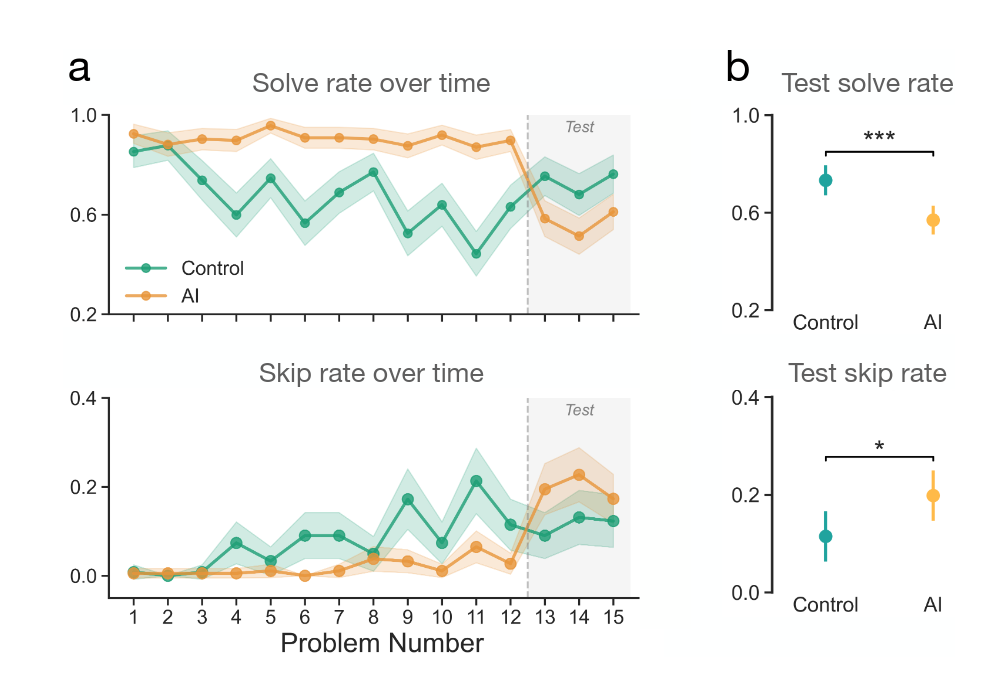
The solve rate measures the rate at which the participants correctly solved the problem, and the skip rate measures the rate at which the participants chose to skip the problem rather than inputting an answer. We observe that with AI assistance (i.e., the first 12 problems), participants in the AI condition were significantly more likely to solve problems correctly and less likely to give up compared to the control participants. However, when the AI was removed, their performance dropped and they were also less likely to persist with problems (as seen by the increased skip rate). Here’s experiment 2 (same fraction problems, but with an added pretest):
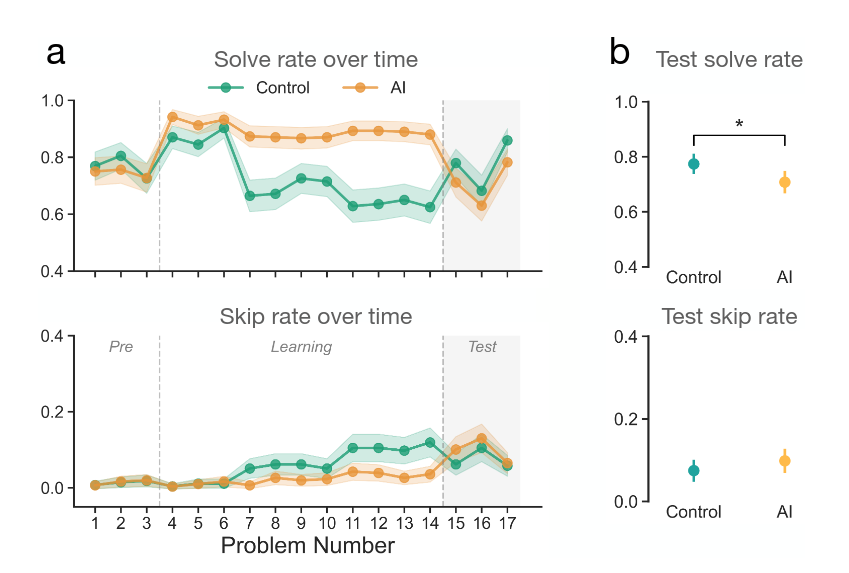 Finally, experiment 3 (SAT-style reading comprehension):
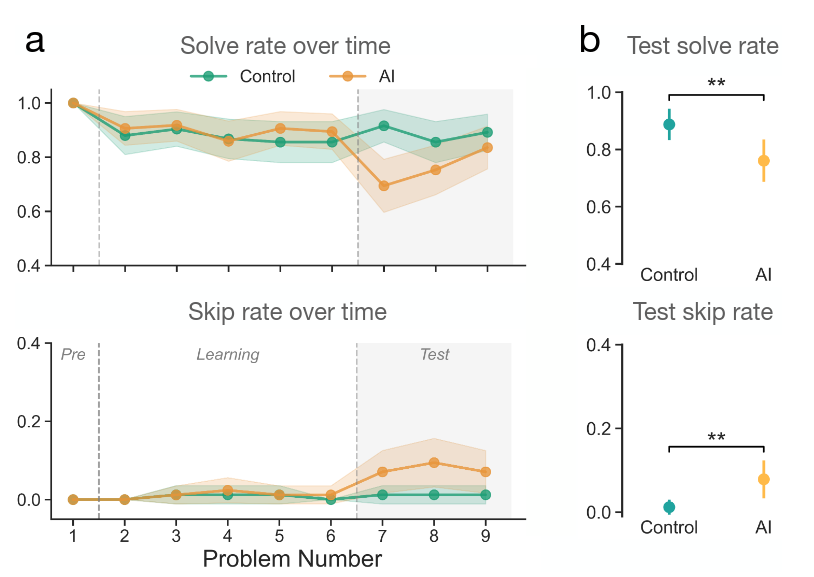 To clarify, people who used AI did worse than the people who never used AI on the test.
“The title heavily implies that just ten minutes of AI usage makes difficult tasks harder to perform, which is not what the study showed or concluded” and Again, just to make sure we aren’t proceeding on a misunderstanding here, the headline says “persist”, which means to refusing to give up. The definition of persist is not that of perform. Further, I suggest you re-read the research paper. The abstract directly states, “impairment of unassisted performance”
“The conclusion the researchers drew, which is up for interpretation, was that prolonged AI usage may potentially impair people’s ability to perform harder tasks without assistance.” I think you may be confused about how experimental studies work in research. In the experiment, when they controlled the variable of AI assistance, the experimental results showed statistically significant results proving the hypothesis that test solve rate of the control group was greater than the test solve rate of the AI group.
The results of the study are not in question, nor am I arguing against them. I am criticizing the sensationalist title being used in this Lemmy post.
The study does not say that using ChatGPT for 10 minutes erodes your ability to perform hard tasks. You yourself acknowledged this in the information you provided from the study.
So I guess the question is, what exactly are you arguing against?
Once again, to reiterate, my complaint is about the misleading clickbait title.
The vast majority of people who see this post aren’t going to read the study. They’re going to look at the title, nod their heads, and move on. I’m simply trying to provide some context.
This is a really smart take on things.
Yah this should be pinned
Yah. Turtally.
Agreed, I tend to get more interested in topics and learn more than I expected, for new neural networks. I think it’s like any tool and using it right can be useful. Our brains can make new connections learning about different topics and how they are related, systems thinking and problem solving. We can search online and read the sources directly too, and verify more with increasing importance of the topic. For example, going to defend yourself in court, do a lot of research from quality sources and still reconsider lol. Just like large claims require large evidence, same idea for other resources including llms, and no need to avoid it like it’s some new Witch panic. The energy people use daily mindlessly absorbing video streams is more than text based llm use and follow up confirmations.
Learning new things and recognizing connections between topics is beneficial for the brain, as it strengthens neural pathways and enhances understanding. This process, known as neuroplasticity, allows the brain to adapt and improve its ability to learn over time
Seems like a biased study yea. Why not get someone to do something manually first without AI, then give them AI to see if they do it better or worse?
I was going to argue against this, but i don’t feel like doing the research myself.
I’ll reddit your lemmy so good baby
LLMs are a competency chipper and credibility solvent.
My observation from having to deal with entities which have engaged with LLMs, is any competency or credibility they may have had, is eroded proportionally to their level of exposure. It’s analogous to experiencing a traumatic brain injury.
Losing cognitive ability is bad enough, but it’s devastating when they never possessed it to begin with.
Deferring all your work to anything or anyone would do the same thing.
That’s not a llm unique problem but a byproduct of not engaging your mind or skills. You can still do that while also using an llm or taking on human help.
If you hired a human to do everything for you, you also end up becoming a potato.
The problem is that llms make it too easy for people to actively choose that route because of lack of self discipline or desire to improve.
But a lot of technology is like that and not just computer tech.
On the other hand I have seen llms write better emails (with better understanding of the subject) than less competent colleagues. Some people are already very intellectually challenged to begin with and were able to hide it well.
They would be in the devastating category.
Yeah they basically disappear behind their new tool, as the only contribution you now see is the one coming from the plagiarism machine.
Yeah, if i would employ my local LLM in a “solve every simple thing for me” way, it would degrade my mental acuity too. I only defer it to areas where i don’t have any fucking clue about anything anyways or struggle very much to reach an usable result, and i do not just accept whatever was spit out, i engage with it and try to understand what is happening and why, including experimentation with my own modifications of whatever i was given.
Good examples of that is my constant battle against RegEx, sed, awk and the like for string manipulation in linux. I struggle with the syntax a lot (the rules themselves are becoming clearer to me by now, mainly because i analyze what the LLM output really does).
I started at a point where i could just confidently say that a ? is a wildcard and a * is a lot of wildcards in a row, and escaping things is something people do. Nowadays i can form most simple RegEx without consulting the LLM at all.
So we really have to put this in another framework: Do you use it to replace your own thought process? or do you use it because you genuinely do not know how to solve it and are willing to learn?
For the first experiment with 354 participants, one group was tasked with solving 15 basic fraction problems without help, while another had ChatGPT open on the side to use for assistance and to even ask for the answer. The group with AI access started off more accurate than the group without it. Then, after 12 problems, researchers took away the AI tool. Almost immediately, the people in that group stopped solving questions accurately.
A similar thing happened when they ran the experiment on a second, larger group of 667 participants. Whereas the AI users got answers wrong or gave up entirely when the AI assistance was withdrawn, the group without AI stuck with the task and were more successful at the end.
Researchers then ran a third experiment with 201 participants and an SAT reading comprehension prompt. The results echoed those from the fraction problems: When the AI tool was removed, persistence and accuracy dropped.
Now you need a human control. Provide a human assistant to do the same.
Is this a problem of AI or a problem of dependency.
Cause from my understanding of the topic this same phenomenon happens when people are given too much assistance of any kind form any source.
Not many people will actively drive themselves if given a solution with low barriers.
It’s such a common thing it’s been a trope among noble classes though out the ages. If you coddle someone they go full potato.
I wonder if this kind of test would show the same results if you compared people using calculators for math problems vs. those without. From the basic operations to doing trig and calculus, if you provide an easier way they’re going to take it, and unfortunately not going to pick up on how the answer is obtained, which an LLM will usually tell in the process. Doing something yourself always teaches you better than watching it, or just being told the answer.
If the tests are implying or showing that people who already were proficient in doing these tests and would have done well without started declining after exposure to an LLM’s help, and that persisted… that’s a different problem and one that should be looked into. Losing skills you had because of help? That shouldn’t happen.
A lot of pro AI people like to compare LLMs to calculators but it’s not comparable at all unless the math you’re doing is simple arithmetic. If you’re doing calculus, the skill you’re working on isn’t arithmetic, so the calculator isn’t much of a factor. Lots of people forget how to do long division after using calculators on the other hand.
Losing skills you had because of help? That shouldn’t happen.
That’s exactly what should happen. Cognitive thinking skills are use it or lose it. If you use an LLM to replace your brain, your brain will get worse.
It’s funny because I actually think learning math the old fashioned way is super important. I used to struggle with math a lot as I’d always had calculators. I went back as an adult and got some old 1980s math textbooks based on Soviet pedagogy (widely considered the best for math at the time) and the impact has been huge. I’ve been building from the ground up math skills that got entirely skipped in school, and feel much better about it now. Calculators are useful but when LEARNING math they should not be used imo. Except maybe to check an answer after you already get it. Doing difficult things is good.
Tech evangelists rely heavily on logical fallacies. False equivalence is one of the main ones. “A thing happened before therefore this tech is nothing to worry about”. They’re redirecting the argument to bait people to try to prove why calculators are bad. But of course the past already happened and nobody is going prove otherwise.
Yep, especially in mathematics a calculator is not much of a help in calculus. The moment you put numbers in whatever thing you wanna solve is the point where the hard part is already done.
Speak for yourself lol. I failed calculus the first time because my algebra skills were shit and it had nothing to do with calculus
That’s an issue with your teacher putting the focus on the wrong part. Sorry you had to experience that. My math skills (which were mediocre at best at the time i left school) skyrocketed the moment i got a teacher that made sure we understood the calculus part and didn’t even want us to insert real numbers.
I hate that I never had a good math teacher and that the ones I had made me hate maths.
I would love to like maths, but there’s too much trauma there.
I’ve taught myself what I’ve needed for work, but it has never been a pleasant experience.
Bad math teachers are a plague on humanity.
but it’s not comparable at all unless the math you’re doing is simple arithmetic.
That’s what they were studying on the math side
For the first experiment with 354 participants, one group was tasked with solving 15 basic fraction problems
Also
If you’re doing calculus, the skill you’re working on isn’t arithmetic, so the calculator isn’t much of a factor.
Calculators would be a big factor in solving calculus problems. Haven’t done calculus in a while but if I recall correctly you are breaking down or rearranging the problem into smaller steps that are more basic arithmetic. One part of a calculus problem could be finding out what the square root of 7 is , if you have a calculator to do that you’re more likely to solve the problem more accurately and to not give up on the problem, which were the two metrics this study was looking at.
Realistically, you would just write root 7 as a coefficient of your answer if you’re performing this math long hand. No one really expects anyone to be able to calculate things like that.
Over time yes, but this says skills were lost during a single session or short term. It was a random group of people, so unknown on what skills they did have before. I think what they observed wasn’t a permanent loss, but a placebo effect of having extra help and it was taken away, so for the rest of the test they felt lacking.
My example of calculators was implying one that could do the test work. All calculators have trig functions, and some have calculus abilities. Would a student forget how to find cosine if the calculator was taken away, or do a derivative of a function? Not in one test. But if they were using it first half and then had to do it themselves for the rest, I imagine there’s some psychological stuff going on that makes you feel like you’ve lost that skill.
They were tested on fractions
Did you use an LLM to summarize the study for you or something?
And reading comprehension.
We’re discussing the effects of the test, not what the test was.
The content of the test is relevant to the outcome
Doing something yourself always teaches you better than watching it, or just being told the answer.
A neat result from pedagogical studies is that being given the worked solutions to new problems to study from is much more effective for learning the material than simply practicing.
Students who were assigned practice problems performed worse on later tests than those given the same problems and all of the worked-out solutions for them. The explanation from the research was - when learning a new topic, immediate practice isn’t beneficial because the student doesn’t yet know what to practice. If they are lost when trying the problem, they can easily end up practicing the wrong skills by not knowing where to start. Those with the solutions have some of the cognitive burden removed, and are better able to internalize the task and generalize it to later problems.
I completely agree with you on LLMs and I think they’ll be a disaster for education. But I’ve always found it interesting that being given the answer can be useful for learning in certain circumstances.
A neat result from pedagogical studies is that being given the worked solutions to new problems to study from is much more effective for learning the material than simply practicing.
Finally, something to justify my still-existent hatred of my middle school geometry teacher for literally telling us ‘the theorems are on the board’ any time we asked her for help trying to solve a problem or for her to show us an example problem. Why the fuck were you even teaching.
There are different ways to learn, some work better for certain people than others.
I would think that the best way to learn is neither of these options, but to be taught how to do the work by someone who understands (like a teacher) and then made to do it after it has been thoroughly explained to you and practiced with you.
That’s what works best for me anyhow, that or literally reading the textbook, lol, but that’s less efficient time-wise.
That was one of my gripes with my experience in college vs hs. In my hs at least, we were taught the most difficult combination of a problem and then everything that we practiced would be able to be worked out from there. In college, we were often taught the simplest example and somehow expected to derive the most difficult version of it on the problem sets. That’s how you get students who study really hard for an exam and half of them fail. They never taught the proper way to solve the problem!
I was out of college by the time LLMs came out but I still believe they could be helpful in this scenario if fine tuned and limited as a tutor not an answer-giver. Obviously if you have access to a good human tutor (who doesn’t call you dumb like my friend had at the time), but I didn’t have access to one.
Immediate practice on something you haven’t been walked through yet? I guess the way I phrased it made it sound like jumping in yourself with no guide is better. You definitely need to be taught first, or at least as you go, and not figure it out on your own. The point was that simply watching someone do something isn’t enough, you have to develop the process of getting to that point yourself. But only after seeing that route, otherwise you will take lots of wrong paths.
Calculators don’t help with reading comprehension (3rd Test)
Also, they’re not talking about trig and calculus, they’re talking about fractions
You know (hopefully), like 1/5 =0.2? Or 6/18=1/3=0.333?
Yes, I’m aware of what they tested and what fractions are…
I was just expanding the point to other things that are comparable. And an LLM for a reading comprehension test is exactly what a large language model would be best suited for, so in essence a language “calculator”.
Doesn’t change the rest of the discussion, which was about the brain’s ability to jump back into things when the crutch is taken away.
I don’t think it’s fair to say that fractions are similar to trigonometry and calculus aside from the fact that they’re all types of math
Very few people do trigonometry or calculus in their heads, I’m sure most people who know it really well could do a cosine on paper, but that’s a much higher level operation than a fraction
Um, you know all of those were developed before calculators, right?
I learned both trig and calc on the principles in how they were derived, so yes, when I was learning and using them, I could do some of it in my head or with a few figures on paper.
But I never said “similar” at all, I was using them as comparable subjects that could be done by hand or with aid.
You’re so obsessed with calling out someone on not mentioning fractions you’ve missed the point of the test, article, and this thread. They use fractions because it was above simple math but not so high level that some of the random people picked might not know it. Which going back to the real discussion, having randoms whose skill isn’t known even halfway through the test might have been a flaw in the test.
Um, you know all of those were developed before calculators, right?
What does the timing of the advent of the calculator have to do with what I said?
But I never said “similar” at all, I was using them as comparable subjects
I would contest that they are comparable subjects. Entry level piano lessons and music theory are both technically of the same subject, but wildly different in practice. One is suitable for beginners or lay people, the other is not.
You’re so obsessed with calling out someone on not mentioning fractions you’ve missed the point of the test, article, and this thread.
You are projecting your own obsession of using the poor comparison of “AI = Calculator” onto me. That’s why I keep bringing up fractions, it is an easy-to-understand (for most) rebuttal to your logically fallacious proposal.
They use fractions because it was above simple math but not so high level that some of the random people picked might not know it.
Exactly, that’s why your comparison doesn’t work.
Which going back to the real discussion, having randoms whose skill isn’t known even halfway through the test might have been a flaw in the test.
What changes would you make to the experiment to remove the flaw you’re perceiving?
How do you expect that change would impact the outcome?
As I’ve said before, the abilities of the ones with ChatGPT assist don’t seem to be known, as they started off with help. The assumption is that they might on average be the same as the others, but we don’t know that. A simple fix to start is to offer the LLM help in the middle of the test for them, see how the curve of ability goes up and down, and compare before and after.
Not answering the rest, I was more interested in the study and what it was claiming and not arguing about missing context of commentary. I think the study may be right in suggesting people today have more trouble understanding things than they used to, but it’s far deeper and older than LLMs. They are just the latest part of the bigger problem.
Some kind of comparison group would have made the result more informative.
Replace this with math and calculators. Similar results? Then it’s not AI’s fault, but a known phenomenon.
Of course, they would never even get the funding for this “experiment” if they didn’t have AI fearmongering in the title.
deleted by creator
You can’t do fractions without a calculator?
I assume you’re also a fan of AI then?
A calculator doesn’t stroke your ego and you know that. That’s why you like and use AI.
Jokes on you. I never persisted at doing hard things because I had no idea what I was doing. Now I get into all sorts of shenanigans because I do what ai tells me to do.
Shenanigans.
That’s not 37 pieces of flare!
Pretty much my situation. My local AI has whipped up some compatibility enhancements for a 2006 game, and about four save editors. Right now, I got it researching The Oregon Trail 2021’s character sheets for editing.
When a Qwen4 Flash is released, I will be looking in recompiling some Windows 3.1 games.
Using a lighter for 10 minutes erodes your ability to persist at starting a fire with two sticks to :)
Truth is in the middle somewhere. I can still fix/make the things I made 2 years ago, but i’m going to use AI tools to do things that it’s passable at while the tokens cost me $20 a month.
My homelab went from bare minimum with not enough time to ansible jobs to deploy any product I want to play with in a week.
Agree. With homelab being a hobby but time being a scarce resource; with AI I’m able to get past the things I hate that are mundane and that I would never find time to improve while still doing the things I enjoy with the hobby.
Also working in a job where there were never enough resources to do the tasks that were high priority, meant we also never improved on technical debt. Now that has turned: we are able to use AI assistance to deliver a higher throughput while fixing more tech debt. Just a different take than the “AI produces low quality code” position.
Yeah. I don’t reall like using AI but it has helped me a couple times with homelab and other PC related issues when even after 45+ minutes of searching the web I found nothing useful and barely anything pertaining to my issue at all.