

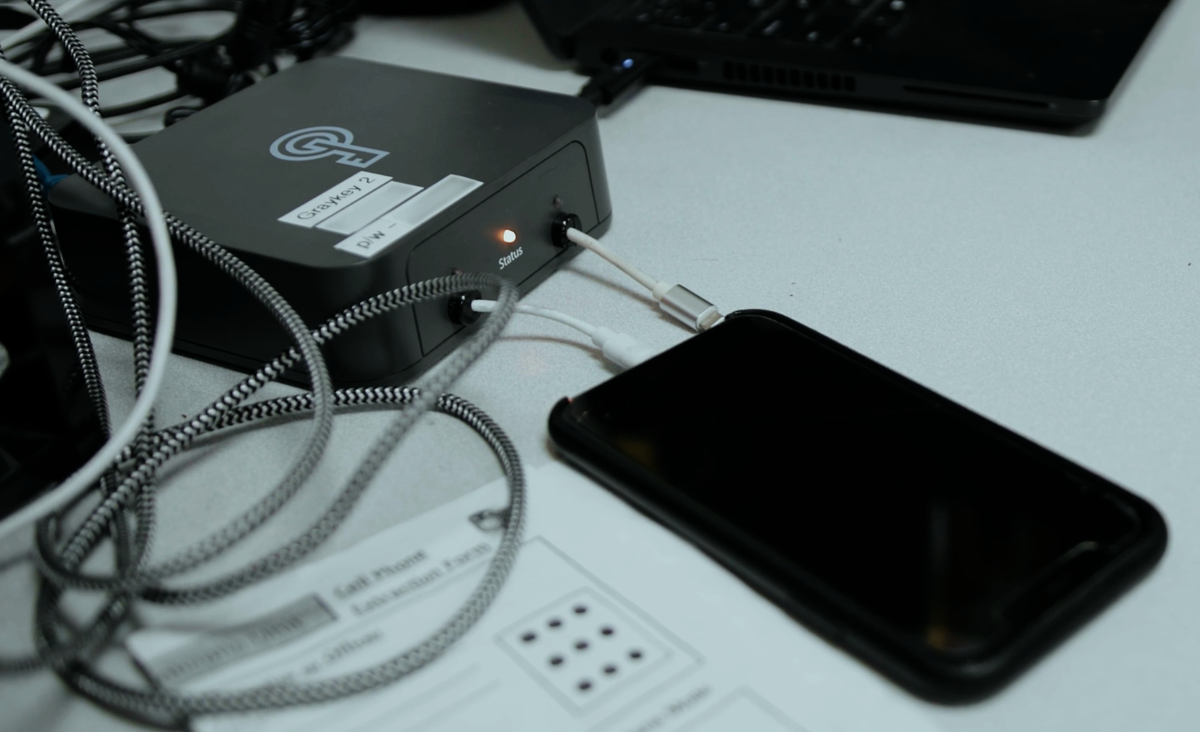
A company that makes phone hacking devices claims to have developed a solution that freezes iPhones in a state that lets cops more easily access sensitive data inside them, according to a video obtained by 404 Media.
This is the latest salvo in the never-ending battle between Apple and companies that help cops — sometimes those in authoritarian countries — break into iPhones.
In November 2024, 404 Media revealed Apple quietly introduced a new feature in iOS that automatically reboots an iPhone that has not been unlocked for 72 hours. The idea behind this so-called “inactivity reboot” is to revert the phone to a state that makes it harder for police to break into the device, and thus extract sensitive data from it with forensics technology.
At the time of Apple’s change, law enforcement agents expressed concern about this new feature, given that oftentimes they can’t immediately try to break into iPhones that have been seized. That could be because police are still waiting for a court authorization to do so, or there is simply a backlog of devices to unlock, for example.
I’m a law student in the US, so I’m actually privy to this information in the form of all the talks that they have judges and lawyers giving.
You may not assume that the US judiciary is healthy and functioning, but it is not as broken as most international observers (or chronically online Americans) think it is. In particular, if you have been observing the Department for Justice’s results recently, you’ll notice a few things:
So in short, you are partially correct and partially wrong. The judiciary of the US has shown to be remarkably resilient considering it has withstood two years of a fascist in power and in full control of the legislature.
Go learn about the harmless error rule. You are incredibly naive. DAs and cops break the rules ALL THE TIME because once there’s a conviction the burden of proof shifts and a defendant, now convicted, in prison has the burden of proving (somehow, while behind bars) that in a theoretical other version of reality they wouldn’t have been convicted had the error not been made.
It’s a nearly impossible standard to meet, especially difficult after conviction, and the remedy is not even necessarily release, merely a new trial.
Not only that, even if a judge and DA and cops violate a defendant’s rights OVER AND OVER they still almost always apply the harmless error rule. Even if the trial is essentially infected with bias and procedural corruption (what could be deemed structural error), courts do not care.
Many decisions the court makes are just denials without opinions also, so it’s not like the court always even justifies why they ignore a convicted person’s request. In other words, the appellate cases you’re reading as a law student showing one defendant got released over an error is a cherry picked case chosen by the court either to create the illusion of a fair functioning system or chosen because the situation is so egregious (that means terrible) that courts will look bad if they don’t overturn it.
But no, there’s nothing functional here.You’re privy to nothing if you don’t understand that things haven’t really been functioning for a long time, primarily because the harmless error rule allows corrupt DAs cops and judges to do almost anything.
With respect, we might not be observing the same things at the same places. I saw an DDA blow up her own case (defendant accused of putting GPS tracker on ex-girlfriend’s car) by accidentally mentioning that they traced a GPS tracker back to [defendant’s first name].[defendant’s surname]@gmail.com, and the judge decided this was fatal to their case because they forgot to put the name of the GPS tracker company employee on their witness list.
This guy was 100% guilty. Two witnesses saw him do it and they found his fingerprints on the tracker.
State v. Landon Heath Higgins, Oregon Circuit Court, case number 23CR14417 if interested.
I don’t know the circumstances, but occasionally judges toss trivial things to punish DAs for messing up. It rarely impacts cases with larger punishments. You’re likely referring to a misdemeanor case where the defendant may have gotten a plea deal for 6 months and had a good job and time in jail would have messed that up and resulted in a waste of county resources. Also, things like this occasionally happen to create the illusion of legitimacy. I am not sure if this is a case you read or if you witnessed the judge’s ruling, but the fact that you’re using what is likely a case that carries less than 365 days max time as an example of how a judge will destroy a DAs entire case is in itself revealing.
Have any circuit court examples of cases carrying 10 years? 20 years? Life? No? Oh, I wonder why. Are you a clerk? Assisting an ADA? You’re completely biased and want to see things working. Go read about how impossible it is for the harmless error rule to get overcome on appeal, go read about how structural errors are essentially ignored or the remedy isn’t even release but just go back to start. There’s plenty of articles about this.
https://harvardlawreview.org/print/vol-131/harmless-errors-and-substantial-rights/
https://columbialawreview.org/content/criminal-procedure-rights-and-harmless-error-a-response-to-professor-epps/
I also once saw someone steal a soda from a store and was going to get a month in jail but the judge tossed the entire case because the DA made a procedural error! The system must work!
First of all, you’re doing important work and I wish you well in your studies and career, for everyone’s sake.
Thanks for the insight. Definitely some positives there. When ICE have added an innocent person’s data to be absorbed into (eg) Palantir’s database, how confident can we be that it is actually removed again?
If this is illegal (which I am not convinced that it is, even though it certainly should be), then a judge can order Palantir or the relevant government agencies to destroy the data. If there is a question about whether this order will be complied with, the court can appoint a special master to oversee it, but this is rare. Usually what happens is the court will take their word on it, but if it turns out they lied, then the court will impose a stiff penalty for contempt of court.
I guess this is my main point of concern right now, as an outsider. I know that the courts are still ruling against Trump and the Republicans fairly regularly, but then I hear about situations where they’re simply ignoring the courts’ rulings and little seems to actually happen as a result.
What do those “disciplinary referrals” actually do? Do people actually get fired, or is it just something else for the Republicans to ignore?
There has to be a mechanism of enforcement for an order to having meaning. For non-lawyer disobeyers, normally what a judge would do is hold someone in contempt and have federal marshals or sheriffs arrest the person. In this situation, no federal judge is going to request the US Marshals arrest a member of the Trump administration because it would create a constitutional crisis and because the executive legal team would immediately appeal it to his Supreme Court who would overrule them. So a smart judge doesn’t want the crisis and knows they will get overruled and won’t use federal Marshal arrest power. As a result, there is no mechanism for non-lawyers. A lawyer like Janine Pirro may have to deal with an ethics complaint, but most of the people in the executive branch doing arguably illegal things aren’t lawyers. So then what? There’s no solution to this, it’s uncharted territory and a complete disaster.
Disciplinary referrals are issued against lawyers who break the court rules. Contempt of court is used against anyone (lawyer or not) who violates a direct order from the court. A lawyer who blatantly violates an order may receive both a disciplinary referral and also a contempt of court penalty.
Before a court issues a penalty of any kind against anyone, they usually issue what is called an order to show cause, which essentially means the party accused of violating the rules must appear before the judge and explain why they should not receive a penalty.
Disciplinary referrals are addressed to the state bar association, which are organisations comparable to guilds which license lawyers. The bar association can impose penalties against the lawyer which include:
An example: Rudy Guiliani was a Trump lawyer who filed submissions before several courts containing information he knew to be false and raising allegations he knew were unsubstantiated, as a part of Trump’s scheme to overturn the 2020 presidential election. The New York bar association disbarred him for this, and the DC bar association took note and automatically disbarred him as well. His legal career is finished; he cannot legally be employed as a lawyer anywhere in the country.
Contempt of court is an inherent power of the court to punish people who violate its orders. A judge can, on their own initiative, declare someone guilty of contempt of court and impose a punishment for it, which could include:
Example: A lawyer was fined $10,000 in March 2026 by my state’s Court of Appeal for submitting a brief containing AI hallucinations.
More legitimacy theater.
deleted by creator
Ah, so as this progresses the Republicans steadily run out of “competent” lawyers because they keep getting disbarred (or quitting to save their legal skins), leaving them with increasingly incompetent ones that have an even harder time accomplishing stuff.
Here’s hoping their legal wells run dry quickly, I suppose.
Remember in the early days of Trump II when we were hearing about entire US Attorney’s offices quitting in protest? That no longer happens, but that’s what happens when top brass asks experienced, career lawyers to defend positions they know are indefensible, and insists they sign their name to hot garbage, that they know is the same kind as what got Rudy Guiliani disbarred.
So yes, the Trump Justice Department is indeed running out of good lawyers and that’s why the US Attorney’s Office for DC is led by a Fox News commentator who happens to have a law degree.
jeannie piero, the drunk lawyer.
they will have to keep sourcing them from legit law firms, but law firms require them to disassociate from the firm before working for someone like trump or gop.
The judiciary really needs to start using “Imprisonment until the person complies with the order” a lot more early, often, and against people higher up in the DoJ org chart.
Judges generally issue escalating sanctions. A verbal admonition first, then a verbal threat to impose sanctions, then an order to show cause, then actual penalties.
Despite what the media reports, the Administration always folds and complies because it would be embarrassing to have senior officials or government lawyers actually penalised for failing to comply with a court order.