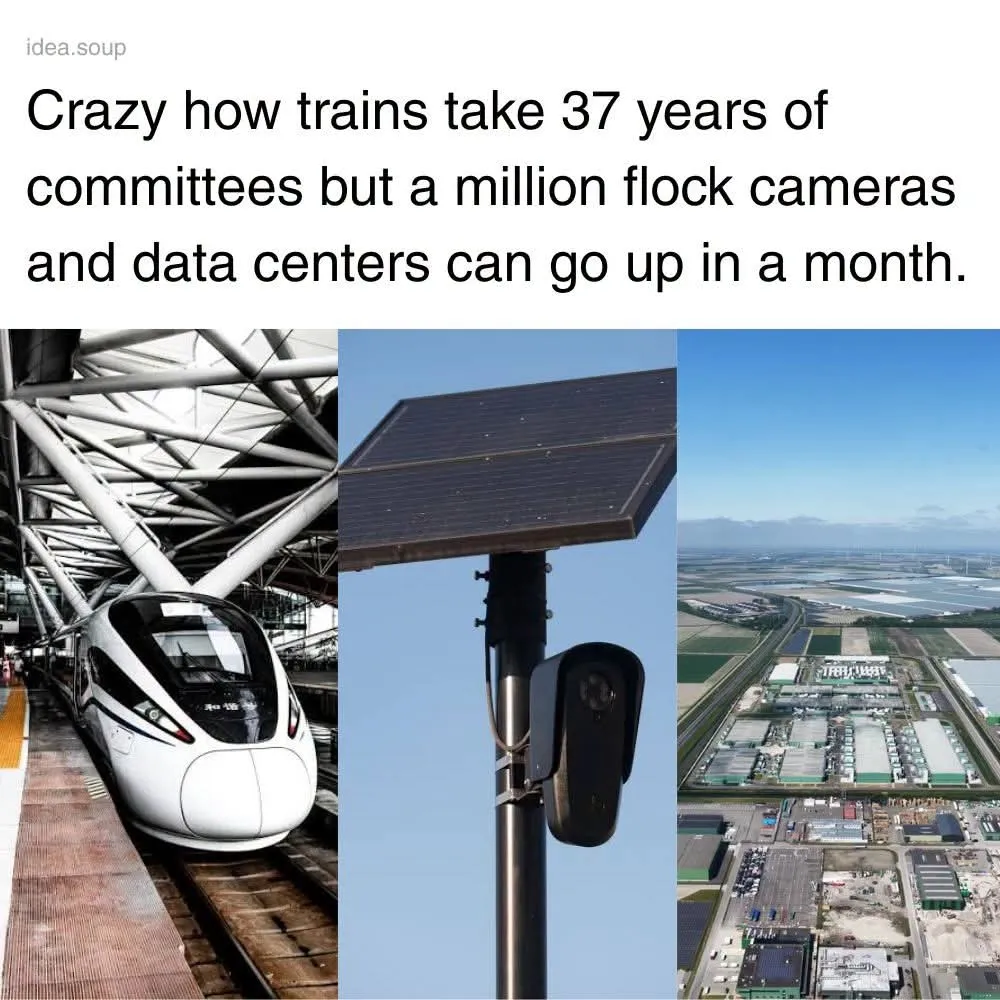
I mean… yeah. Trains have had a lot of arbitrary obstacles put in their place. And it goes without saying that Flock and AI datacenters can fuck right off.
But trains also are much, much more complicated projects. A flock camera needs like 4 square get of space next to the road that’s already in the ROW, and data centers are built a single piece of land.
Trains, and especially high-speed trains require securing of land and grade separation/fencing that makes their installation very difficult from an engineering and property-ownership stance.
Roads can just be routed between property lines as much as possible because cars can make pretty sharp turns. High-speed trains have to cut properties in half, build off grade, and put up a fence.
Imagine you’re a farmer and they put a trail line android your property. Now to get between the house and the barn that was 100 yards away you have to travel 2 miles down the track to the nearest crossing, so you’ve made a 200 yards round to 8 miles. Yeah, you’ll get paid"fair market value" for the 50-ft wide strip of land their treasure from you, but with half your land cut off from the rest the damages are much higher.
You don’t want that, so you sue to stop it. And so do thousands of other property owners in the same situation. And the business owners of the roasts that will be bypassed, cut off, or simply used less. And the cities and counties who now have their existing transportation infrastructure fucked.
It’s a huge impact, and even if it’s a net good, there’s severe collateral damage and those imitated will fight to stop it.
The time to secure rail rights was 150 years ago. And that’s what they did and why that’s where pretty much where all the rails are.
you’re ignoring the spirit of the post.
when the wealthy want something done, it gets done.
nothing you’re talking about is outside the power of government… do you want someone’s land? then you just take it. nobody is going to put up a fuss for longer than a few months.
and when they do put up a fight, you crush them or pay them off.
we don’t have anything good because nobody in power is interested.
Highways are not nearly as easy to construct as you make them out to be. Especially in metropolitan areas their (not so much) smaller possible radius is counteracted by much larger area requirements, gigantic interchange areas required, pollution and noise that is destroying land values in a wide corridor … Also regarding pedestruan crossings, highways are no better than rail. They are actualy worse as crossings have to be much longer.
What you consider showstoppers for rail are consequences of countless recent highway projects, that were miraculously not impossible to construct.
It is BS that real estate can be routinely sacrificed for highway widening and even brand new highways but not for modern rail infrastructure.
The rails we need for a real rail network are the long-haul rails, and those are much harder than highways.
Yeah, i10 is like 20 lanes forna few miles in Houston, but just a few miles out of town and it’s 2 lanes wide for the next 200 miles to San Antonio where it gets a few more lanes, and is then 2 lanes for the next 500 miles to El Paso, then gets a bit wider, then is 2 lanes for 300 miles to Tuscon, and so on.
And along those 2-lane stretches the roads are very flexible in their placement. It’s why they’re not straight. They constantly turn left and right to avoid splitting properties, cities, etc in a way a train (especially a high-speed train) simply cannot. And they’re built largely at grade. When there’s a hill the road can follow the hill, wheras a train needs a tunnel, bridge, or trench.
Rail’s requirements for flat, straight paths and the extreme braking distance of trains combined with their inability to turn independently or operate off track makes them a much more difficult project in terms of engineering, logistics, politics, and legal issues.
Outside of town is high speed rail also less of a headache to build. Sure, you need more tunnels and bridges but for example the LGVs in France have surprisingly high gradients, so they can follow the landscape better than many people believe.
I am not saying that HSR is easy to build I am merely saying that they are not such an existential challenge as US Americans make it out to be. Even developing countries manage to build them, highly developed ones manage it and everyone in between. The problem in the US is not that that the technology is so challenging. The problem is legislation that is extremely hostile towards such projects, creating overhead costs that are multiple times the entire project costs in other high cost countries. The problem is a lack of political will and the problem is especially ideology, the idea that rail infrastructure has to be profitable to be justifiable (road infrastructure interestingly is not having that requirement more often than not).
PS: “extreme breaking distance” and “inability to turn independently or operate off track” are not an issue at all, why would they be?
The braking distance and inability to turn is why greater physical barriers are required to separate rail. If a cow walks onto a road, the car drivers can stop or swerve. And even if they hit the cow, the entire network isn’t shut down during the cleanup because people can drive around the wreck.
The inability to operate off track means the system is less flexible because it requires rail everywhere, and the rail spec has to match the train.
Cars operate better on nicer roads, but they’re capable of driving on any pavement, on gravel, dirt, and more. A car has no issues transitioning from one type of road to another, can be more easily re-routed, and is just generally more adaptable.
Rail is great. It can move a lot at once between designated points, and as long as that’s all you want to do and it’s all working that’s great. It works really well in specific circumstances that happen to match the needs of much of the world. But the thing with a lot of the US is that it wasn’t really settled until there were air conditioners and cars, and so it was development with both in mind, and is very difficult to adapt rail to those developments. For rail to work in the South, the whole system from first mile to last must be solved at once because none of it works in isolation.
Houston tried. They put in a light rail system and it super duper sucks because you still have to drive to Houston, pay to park in a giant lot, pay to board the rail, then walk the last 3/4 mile in 110° heat or wait 20 minutes to pay to take a bus in 110° heat. The alternative is just to drive to your destination and pay to park in the garage for less money. And even that shitty system uses up half of Houston’s sales tax.
The system needs commuter lines going into and out of the city, but those need the light rail. There also needs to be a way to get from your house to the commuter train. It’s a 4-part system (first mile, commuter train, light rail, last mile) that ALL needs to be in place for any of it to make sense, and that’s extremely difficult to implement.
They would have to seize new land, build new tunnels and bridges and essentially start from scratch to build functional rail, and if you want it to pass through major cities that gets extremely expensive. Flock relies on existing mass produced tech (they’re essentially a bulky cell phone with fewer features, a small solar panel and a pole. They already had the land, just needed govt permission to use the existing easements. And Flock is making money vs spending trillions with no ROI.
You’re noticing a bit too well citizen…
The fascists weren’t the ones trying to build high speed rail, the decorum folks were. In fact, elmo’s entire role was to suck out budget/enthusiasm for the promised future, fail like he’s best suited to do and say oh well, too late.
If you’ll allow me to nerd out a little. I love trains as much as the next guy. I also love arriving at the next station alive. Every single time. And i also want my grandchild to arrive at the station Alive. Every single time.
But by the time we start to actually lay down the tracks, a whole lot of work has already been done. Ground has to be sampled along the way. The ground has to be prepared, large boulders has to be cut/blown apart. Engineers and geologist must have had time to calculate that the ground will hold, perhaps certain areas needs to be reinforced more than others The ground has to be owned by an entity that can authorise the use of it.
Signal cables has to be drawn. There has to be space for trains to pass eachother. And then there are probably solutions to things we didn’t even know was a problem.
What’s my point? Of course trains take a lot longer than setting up a bunch of cameras on poles… I’d be more concerned if it was the opposite. And yes, I’m hillarious at parties.
It’s also been known that when laying track over large distances, a site of archeological importance has been discovered, this can delay the project for years whilst it’s examined.
Rights of way need to be negotiated and secured. This is a big one.
This is the biggest one in the US. The right to keep the government from ruining your land makes building trains extremely difficult and the legal process is extremely expensive and time consuming
FWIW, while you’re not incorrect about the build process part, this person specifically mentions the politics and paper process required just to get approval to start conducting land surveys and the like, so his point is valid too. Also fun at parties, cheers!
No it’s really not.
Flock is a massive evil. But there’s zero planning required. They’re completely self contained, solar powered cameras. You can put them anywhere. Thats their entire selling point.
You do not need any new infrastructure whatsoever.
Got a stopsign? Strap a flock to it.
Street light? Flock camera.
Tree? Flock camera.
There are no land surveys to do. No finding a site. No dealing with property ownership issues. No construction. Nothing at all other than telling Flock “yeah sure strap a camera to this existing pole”.
A flock camera requires about as much planning as slapping a sticker onto a street sign. They’re not even remotely comparable to fucking trains lol.
And you’re right to point out the distinction but I’d mention another distinction that in the states a rail plan crosses multi state jurisdictions, zoning, needs, electorates… all that in a country where there are specific political mechanisms designed to make top down federal imposition difficult.
In other words, a data center, or a flock contract is easy to install. It only needs “corruption” aka approval in ONE location. It’s spread is implemented point by point, it’s not like a gas pipeline, fiber cable or any PHYSICAL infrastructure that must cross multiple borders.
A corridor railway, unlike individual cameras or server farms, needs sign off across multiple states plus multiple sectors of public and private land to get started. It is hard to get all those parties and locations to conform and adhere to a plan; all in a country expressly designed to prevent the fed from forcing it all.
That’s before construction gets ever considered. So compare that to installing a flock cam…
The system makes it too hard to get infra built, but the movement looks bad if they seem to think building a train is as easy as it is in SimCity.
A huge part of the reason the planning takes effort is that you need community support. The train might be running near houses or have to demolish housing or community buildings. Similarly, flock cameras are community surveillance, and ought to require community buy-in, but that process doesn’t happen.
My view is that this is because:
- A huge part of infrastructure is less about use and more about separating the rich from the poor. A car lane keeps the driver in a little bubble, away from the poors. A train doesn’t, so the train doesn’t get built.
- A bunch of flock cameras, however, do a great job of keeping tabs on the poors. In they go. Obviously the community is for this, they want to stop criminals right?
And the Chinese build a 50000 km high speed railway network in 18 years. The first high speed train was in 2008. If there is a will, there is a way. Infrastructure benefits the people.
In California for example the high speed railway was authorized in 2008 for only 795 kilometers long. The project is expected to be completed between 2031 and 2033. So in the same time frame, China build 49205 additional kilometers of track.
In western countries, everything and everyone needs to be consulted and 99% of the time a court case follows because of some animal found or it is too close to houses or whatever shit people think of, causing massive delays. Than of course there are the changes in government. Think about the Biden infrastructure bill that got scraped like the second day the current regime took over.
Iam new Lemmy user
The Chinese build a 50000 km high speed railway network in 18 years. The first high speed train was in 2008. If there is a will, there is a way. Infrastructure benefits the people.
In California for example the high speed railway was authorized in 2008 for only 795 kilometers long. The project is expected to be completed between 2031 and 2033. So in the same time frame, China build 49205 additional kilometers of track.
In western countries, everything and everyone needs to be consulted and 99% of the time a court case follows because of some animal found or it is too close to houses or whatever shit people think of, causing massive delays. Than of course there are the changes in government. Think about the Biden infrastructure bill that got scraped like the second day the current regime took over.
Yeah the changes in government is a big thing I think. In the US nobody can be president for more than 8 years (in theory at least, I guess you guys will be testing that in 2028) and in place like the UK no Prime Minister really lasts more than about 10 years at most, and that’s pretty rare. Nobody wants to do all the work and spending on something that will pay off for the next person, so it’s sort of hard-coded into these systems that any project which takes more than a decade to finish probably won’t get done.
China can do it faster because it’s a dictatorship that simply takes the land on which it wants to build rail and pays the previous owner. In the US, there are far more legal hurdles for the government to acquire that land. Too many hurdles IMO, but going full dictatorship in order to have rail built faster is not the way.
Again with the propanda. China is not a dictatorship. People actually have a lot of rights and power.
Even more than in the US, strangely when it comes to privacy for example. China has a system almost stricter than the European GDPR. American citizens can only dream of this sort of protection because your government is run by tech lobbyists.
Anyway you’re making excuses for the inability of ‘the greatest country on earth’ to even build proper infrastructure for the people. Not only high speed rail, but the state of the roads, bridges and other crucial infrastructure is deplorable.
China has had the most dramatic high speed rail transformation, but plenty of European countries have developed solid systems without going “full dictatorship.”
Also, the USA used to skip over a lot of those legal hurdles when it came time to build a railroad (hence the phrase, “getting railroaded”) but for various reasons we’ve lost the political will to do this.
I wonder about that with the UK. We already have a rail network, it’s just old. Presumably we could upgrade it if we really wanted to without having to worry about securing the land, but there’s presumably just no will to do it.
I think part of the problem is that in order to achieve such high speeds, high speed rail lines have to be really, really straight, and as flat as possible. Older railroad right-of-ways are often too twisty, curvy, and hilly. So, sadly it’s not just an issue of new tracks & trainsets, in some cases there will need to be new routes.
At least, this has been an issue for Amtrak here in the USA. Their new Acela trains are pretty fast, but most of the line between Boston/NYC/DC was laid out in the 19th century. So it can only get up to its full speed on short sections of the track.
Trains benefit people, those other things benefit billionaires.
And billionaires only care about one thing.
Control.
*nods in understanding
High resolution images of everyone’s buttholes
That video reminded me when, as teenagers (16 years old or so), some friends and I were searching in internet things such as “How to shoot black holes from the ass?” or “How to shoot niggas from the ass hole?” just for the sake to fuck the day of CIA, NSA and Google employees lmfao
They were surely good times.
Username checks out.
And it’s disgusting
The future of humanity!
Where humanity is defined as billionaires, everybody else are just NPC.
While this is true, trains are hard because of all the different people and companies need to give up their land to do it. Billionaires can just buy a chunk of land and then pay off local reps to look the other way and shoehorn the permits.
Trains would require
imminenteminent domain at a high rate. People generally dont like the government taking their land.Eminent* domain
Thanks, I didn’t reread this before posting.
The same people against this gladly give up their land to pipelines.
Still a bit different situation. Pipeline construction is the biggest concern for most but it’s temporary and they get paid for it. Afterwards, sure they must give easement rights to the owner but afterwards? Out of sight out of mind.
California high speed rail was something my parents voted on when I was a child.
I had this friend who was a year under me in school. Her kid voted for it too.
It still doesn’t exist. California can’t build something as modern and cutting edge as a train.
All the funding was eaten up by Muskolinis hyperloop project that didn’t bear any fruit. All according to plan, now they can sell more Teslas.
Real trains are cutting edge though. But yeah the usa just cannot.
We can’t manage a steam engine.
no you were really good at those! it’s just that you should probably have continued after that.
Indeed, the PRR S1, and the UP BigBoy are purely American, and the first is the fastest steam engine ever, and the second is probably the engine that can handle the heaviest loads with the steepest grades, without a chain. Though there are some honorable mention locos in Madison, IN that have the world record for steepest grade without a chain, but those guys can’t haul what BigBoy can. BigBoy can’t make that particular grade, not because it is too steep, but because the rails are too narrow and curvy. Deisels can’t compete for load weights, neither can electric engines. Un/fortunately both diesel and electric beat the crap out of steam on maintenance costs and downtime.
Fucking shame about Roger Rabbit.
This guy trains
We were, we aren’t.
There’s a lot of good comments here, but folks are overlooking a major structural issue in the USA that IMO is largely at the root of why rail development has become so complicated - and that’s the fact that local jurisdictions are very powerful compared to many other countries. Every city and county along a route (or even potential route) gets a seat at the table, and will work to represent their constituents and economic interests. This means there’s a ton of voices advocating for completing priorities - they want rail to go through their city or county, but only if the HSR gets a stop at their preferred locations. If the jurisdiction doesn’t get what they want, they’ll often work to grenade the entire project.
China, by comparison and for example, has an authoritarian central government that can just dictate a route, displace individuals or communities in the way, and tell anyone upset to pound sand.
Not trying to say that authoritarianism is the answer. We’re well on our way to that, and it’s sure not helping things. It’s just a structural difference in the USA that makes makes such projects far more complicated, expensive, and inefficient.
I’m not saying this thing I’m saying, because we’re getting what I attribute someone else’s success to and it’s not helping
Okay? Maybe there’s some other difference.
If California became it’s own country and stopped funding the red States it could find the funding to build anything really
I think the amount of funding is kind of irrelevant. Our government has lost (or perhaps given away) the ability to actually build anything without an infinite array of subcontractors all trying to fleece the taxpayer for as much money as possible. If the budget was higher, the expenses would simply grow proportionally to absorb it.
The funding, yes. But if we had to actually make a train, a curb, a bollard, a bridge, a consumer gpu? We’d be so fucked.
Well of course. Billionaires are motivated to keep an eye on their livestock, but aren’t motivated to make sure their livestock has a good quality of life. I mean how else can they hunt down a woman trying to have an abortion? That’s their future worker after all…
If you want to build a train in empty space I’m sure you could get that approved pretty quickly. Of course, it’d be useless. The biggest problem with trains is getting land for it since they are most useful where there’s a lot of people.
I hate these data centers and flock cameras as much as the next guy, but they aren’t really comparable. Flock cameras don’t even take up much space and they are put up on land the government already has. It’s like asking why it’s so easy to put stop lights.
Sorry, I’m Mr Buzzkill.
Do what China does.
Buy out people’s houses for the market rate, and give them a plot of land to build their new house on. Find land with market rates similar to the one you’re seizing.
EZ
The USA has no problem bulldozing housing to build highways.
Yeah, but only because that land belonged to blacks and cut prospering communities in half to drown them in traffic hell. You wouldn’t want a repeat of that.
Rip out the extra lanes of the damn roads and highways that induced demand, and we got all the space we need without destroying much in the way of existing buildings. A double track is only about as wide as one lane of our surface stroads.
One direction of high speed rail track would require at just under two freeway lanes worth of width (two directions need ~4 lanes).
And that’s before dealing with the additional freeway/rail safety separation, barriers, shoulders, drainage, etc.
While there are sections of highway that could support this amount of removal, if definitely not as easy as “swap road for track, done.”
I don’t see much of an issue since we already have 8 lane interstates connecting the vast majority of the cities in this country. The HSR could even connect with the light rail using existing bypasses. We have already emminent domained more space than we need, both inside and outside of the cities.
Easy? No. Easier than continuing to support a broken system of highways that hasn’t been revisited in policy since at least the 1970’s? Yes.
The double track I was referring to is the light rail that one would use in urban areas. HSR has no need to expand all the way into most city centers.
In the ideal situation where there are 8 lanes sustained throughout the entire proposed path, that still means removing at least 50% of the current inter city infrastructure. While adding more lanes is always a temporary fix, removing that substantial an amount is simply not feasible and the reason it hasn’t happened yet.
Adding more lanes increases the amount of traffic. It’s not a fix for anything.
More lanes, more space, more people taking the route. It might seem counter-intuitive, but if you want to reduce traffic, you remove roads. Building viable alternatives to cars is the best way, fights pollution and congestion. People will use the trains, trams and buses, if good service exists.
when you are at an 8 lane highway, you are already so far down the wrong path that the status quo hurts as much as ripping the whole thing out and providing alternatives would.
And yet it is possible and feasible in every other country, including ones like The Netherlands that followed us down our idiotic path, until the early 2000’s, and ripped out the roads and gave the cities back to all forms of transportation.
It isn’t possible because no one is willing to do it, other than some of the coastal cities on the west Coast, where it is slow, but works damn well.
This. American roads are widened constantly for no reason other than paycheck justification. They could rip out existing highways (which cause lots of traffic) and replace them with trainlines.
Not sure how true that is. New highways aren’t that common and all the ones I know about took forever to actually get built.
None of this is written in stone. Critical infrastructure should always be prioritized. We see how China did it. In the end it’s all about political will.
We all know that China prioritizes critical infrastructure like flocks of cameras and the associated data centres to closely monitor its population. Hence they are built quickly, whereas trains take way longer then a month to be set up.
bro you have trains but only freight trains
Do those freight trains need to stop inside city centers?
You are proving their point.
Somehow ut still works in pretty much every other country
Yeah, this is cheap ragebait. Most of the stuff online is optimised for that outcome so I end up rolling my eyes most of the time.
Everyone is talking about obtaining land and eminent domain and whatnot. …We have streets. 🤷
I’ve wondered how impactful it would be to pass a law allowing all interstates to also count as passenger train right-of-ways. Obviously there would have to be some engineering and modifications to turn a highway median into a train line but it would simplify the land rights probably.
how expensive would putting elevated rail in the median of the freeways even be?
Overpasses
Move the pillars?
I don’t know where you live but here the clearance on a standard overpass is 14’. This is well under the 12’8 needed for the highway, plus the height of the track base, plus the clearance for the train. So the train would have to be built 30’ in the air. Might as well put it above a road instead.
If you mean “put train on ground in the middle of the highway” we can also do that the hard part is getting to stations not in the middle of a highway.
I vaguely remember something from The Power Broker where an engineer said to Robert Moses with a slight change to the design, at no real cost, they would build the roads so trains could be put in easier at any time in the future. Moses said no. Cars only.
I don’t think putting at grade trains on freeways is a good idea, unless they had a reliable way of warning people minutes before a train comes through
Chicago has a system like this. The main problem is the stations in the literal middle of the highway.
Crazy idea, put the stations at the overpasses. Not all of them, obviously, but you can then make covered walk ways, and hopefully have enough land to put parking decks if needed.
But what about the cars?
They get one lane now. The rest be for the trains
All of that is correct however I am also currently watching my government fail to be able to construct a train station along an existing track. So far the process has been going on for about six years and no one has so much has dug a hole yet. It’s barely even a construction project, they just need to pour some concrete into a rectangle and then add some stairs and call it a station. But apparently even that requires six years worth of committees.
Meanwhile in Scotland, somewhere with similarish land and planning laws. We’re electrifying the whole network, dualing large sections that were single track, removing peak fares, upgrading the rolling stock, and opening brand new stations.
Having a decent rail service is entirely a political choice. Whether those in power want to make it happen or not.
All about setting priorities. One could start a war instead, leading to closing and reopening the Straight of Hormuz, a fuckton of civilian and material casualties and having nothing achieved. What’s more “fun”??? Boys be boys, aye?
Yes, but the US has legalized corruption we call lobbying. And its working out great for us! /s
In early 2010s, I worked in a city that was planning to remove a huge useless highway section. When I moved away from that city in 2025, they were still having hearings about plans to potentially start thinking about removing that highway.
Billionaires hate trains.
Ayn Rand screaming
Maybe we should make pods and build them really long.
There’s a really weird misconception about Amtrak and U.S. railroads.
Amtrak is not some ordinary private corporation. It is a federally chartered corporation, with the federal government as its controlling shareholder. Its board is largely made up of presidential appointees who require Senate confirmation. So, functionally, Amtrak is a government-controlled corporation that happens to operate as a for-profit company.
The stranger part is the infrastructure underneath it.
The vast majority of Amtrak’s route mileage runs on tracks owned by private freight railroads. Those freight railroads are enormously important to the U.S. economy, but the industry is also highly consolidated. A handful of Class I railroads control enormous regional networks, creating what is essentially a series of geographic monopolies/oligopolies. Amtrak itself says 97% of its route-miles operate over tracks owned by other railroads.
So you end up with this bizarre situation where the federal government owns and controls the country’s principal intercity passenger railroad, but much of the physical railroad infrastructure it depends on is privately owned.
And expanding passenger rail isn’t as simple as “just build more trains.” You need track capacity, signaling, bridges, grade crossings, stations, dispatching capacity, maintenance facilities, etc. In many places, you’re trying to add passenger service to infrastructure that is already being used by private freight companies. Amtrak frequently doesn’t even control dispatching on the tracks it operates over.
That’s why the U.S. rail situation is so strange. We have an enormous private freight-rail system that is absolutely critical to the economy, a federally controlled passenger railroad, and an infrastructure network that has been extraordinarily difficult and expensive to expand and modernize.
It’s not simply “the government sucks at trains” or “private companies suck at trains.” The institutional arrangement itself is bizarre. The U.S. essentially split passenger and freight rail into two different systems while leaving much of the underlying infrastructure in private hands.
And then everyone wonders why building modern passenger rail is so damn difficult.
We basically do need to eminent domain the rail network. That should be government owned like the highways.