You must log in or # to comment.
Every damn power plant is a glorified steam engine
Except solar. And wind. And hydro.
Some solar is also boiling water
deleted by creator
Isn’t salt like the main bees knees these days?
I don’t know, but the Ivanpah solar power station near Primm NV, which is a set of three molten salt towers is reportedly getting decommissioned, removed, and replaced with PV panels. Word is PV technology had improved in efficiency and stopped in cost enough that the whole molten salt thing is no longer economically viable, at least in comparison.
deleted by creator
I’m assuming ceramics to the rescue?
:D
Something all the way down something
And zapping birds!
They did fix that pretty quickly, but what a classic mad scientist blunder that would turn a well meaning researcher into a villain in any action hero film.
And some fusion is direct to current in coils. The z-pinch style approaches mainly.
that’s why IMHO it’s more important to classify the core coupling mechanism (e.g. photoelectric effect, electromagnetic effect) instead of classifying the total energy in -> energy out types.
My local solar steam generator was shut down years ago as it was no longer worth testing direct reflector material anymore — even if they had gotten perfect reflectivity they couldn’t compete with photovoltaics anymore
Expect for solar, it’s all just flowy stuff through spinny stuff: wind, water, steam. GRAAAAAAAAAA
Good ol’ mill.
Solar is very tiny flowy stuff through very tiny spinny stuff
Spinny stuff is basically the universe on all scales, so it makes sense. And that’s fucking cool, IMO.
you forgot the electrochemical battery
And wind.
wind is just the effects of premade steam
Hydro also uses steam
In liquid form?
Condensed steam.
It’s still the same turbine shit
It’s all turbines, but quite dissimilar turbines.
and fuel cells
And waves/tidal, but now we’re getting into the really niche types.
i knew i was forgetting something
And theoretically a massive proton exchange plant.
Isnt hydro in a small part powered by steam just post condensation steam.
I do enjoy a nice glass of post condensation steam on occasion
I dunno if “power plant” quite fits for solar and wind. Definitely for Hydro, though.
“Power Plant” won’t be a fitting term until we can generate electricity (at a viable scale) from chloroplasts.
And wouldn’t that just be solar with extra steps?
fun fact: chloroplasts generate an electric potential across the cell membrane during photosynthesis. essentially, they have membrane proteins in their chloroplast membranes that push electrons from one side of the membrane to the other side whenever a photon hits the protein. It’s essentially a natural photovoltaic cell.
That electric potential is then used to create ATP in nature, while we just directly extract the electrical power through cables.
Even better if you can use it to power a humanoid robot for a real world plant golem.
Isn’t that the goal?
You should look at mitochondria:
- The power plant of the cell.
- Runs on a proton-gradient.
- ATP synthase is essentially a molecular turbine and a generator.
- oh. a turbine. Damm thing spins ~18000 rpm at medium throttle, pumping out elec- ATP. ATP.
Oops… it’s turbines all the way down.
runs on proton gradient
So I can launch it from Lutris?
I dunno if “power plant” quite fits for solar and wind
Why not?
The First Law of Thermodynamics: Energy Cannot Be Created or Destroyed
Fossil fuel power plants merely convert chemical energy into another type.
Just that “power plant” I think most people associate with large enclosed facilities that house power generating equipment, which doesn’t quite describe wind and solar farms. Hence that most people refer to them as “farms”.
deleted by creator
Are these really power plants? I thought they were called field or farm or something else
We’re living in a steampunk world after all
I’m a steampunk girl
In a steampunk world
It’s not a big big thing if you steam me
I’m going to be this person I guess, but the defining trait of steampunk isn’t the use of steam alone. It’s that energy is transfered by delivering steam to where it’s used, rather than using it in-place to crested electricity. This means that steampunk machines operate off of some kind of kinetic energy, rather than electrical energy.
Basically, computers (and everything else) are spinning gears, not silicon.
Aaackually…
That was a really cool explanation, thank you!
Readily available, low boiling point, non corrosive (relatively), and ecologically safe. What more do you want?
Also a ridiculously high heat capacity. It does make sense.
Molten salt. Lower pressure, higher efficiency, and I believe less reactive in the event of an uh-oh.
The molten salt is used as the first step. It then makes steam through a heat exchanger. Molten salt is safer next to the actual reactor because water is not a good coolant in case of emergency.
Oh, I was just joking around. What my water system is missing is molten salt.
Although for the sake of preposterousness, I’m going to suggest we use the molten salt to turn a giant water wheel.
Hydro isn’t. Nor is solar photo voltaic, wind, or tidal, but yeah, nearly everything else is. In a combined-cycle natural gas or diesel plant half of the power generated isn’t steam power, but the other half is.
Hydro is liquid steam
aah, but it didn’t say steam, it said boiling water.
smaller gas generators based on internal combustion engines don’t boil water though, right?
boiling just makes the water move, hydro just cheats
Electromagnetic induction.
Basically electric motor in reverse…instead of electricity powering the motor, the motor powers electricity.
But the trick is in “what spins the motor”. In the case if ICE generators, it’s usually a pulley off the crankshaft.
Or it could be moving water.
gas generators based on internal combustion
they heat air, afaik. hot gas expands -> mechanical movement moves magnets -> electromagnetism -> electric power.
Molten ice.
for ccgt it’s more like 2/3 for gas turbine, 1/3 for steam turbine split, even more uneven for diesel/steam because diesel exhaust is much colder
I watched a video a while ago about a new approach to fusion which uses induction iirc https://youtu.be/uRaQLZaaHWo
One of the fusion startups says they can use the plasma B field directly. Basically making the plasma the rotor in an electric generator to induce current in a wire.
I really like this concept, wonder how viable it really is though.
It seems promising, they’re acting like they’re close. They’ve been promising concrete deliverables, I think they’re supposed to have a working model that can actually capture the energy next year
You never know, but they’re called Triton if you want to check them out. They don’t share progress often, but when they do it seems pretty candid about their progress
Please don’t let it be another Theranos, please don’t let it be another Theranos 🙏
It’s not. Maybe they’ll fail, maybe it can’t math out, but it’s not vaporware
I’ve been watching these guys for a while. They have a real shot at getting something on the grid before ITER is even fully operational.
I’m guessing something like most of the magnets contain the plasma, but some transfer energy off it?
deleted by creator
It’s boiling water all the way down.
Seriously though, it’s over 100,000,000° so probably not.
Water decomposes above 3000 C
First, fusion has 0 theoretical economic potential, but there is some potential for energy gains from 2250* + steam. Water deconstructs above this temperature into powerful HHO gas, that when ignited gains another 2500* that will chain react with higher pressure steam to make the steam even hotter/higher pressure. Minor problem of melting all known turbine material, is avoidable through just higher volume of pressured steam.
The one im aware of uses deuterium, aka hydrogen2, to generate helium 3. One of the byproducts being tritium, aka hydrogen3. This means there’s potential for 2 deuteriums to mix with an oxygen molecule,this creating ²H2O, aka heavy water.
I’m neither a chemist, nor physicist. So someone could probably prove me wrong at the drop of a hat, but Im calling it close enough.:p
Which one? My first impression is that ignoring all the energy in neutrons should be pretty inefficient
Helion, probably.
the only things i’ve been seeing from those guys recently are investor pitches…
Yeah, I found what they do here
So they chose deuterium-helium 3 fusion where there is less neutron radiation. Still they need to breed helium 3 where a lot of energy is lost. Curious to see if they will reflect that in the energy production balance.
They seem to have a two stage reactor, where supposedly, the He3 is generated with a ~small energy surplus and then Fred into the bigger reactor.
deleted by creator
Maybe it’s based on this: https://en.wikipedia.org/wiki/Magnetohydrodynamic_generator
There’s a great video by Improbable Matter on YouTube breaking down the issues with helion , well worth a watch https://youtube.com/watch?v=3vUPhsFoniw
https://www.youtube.com/watch?v=m_CFCyc2Shs I don’t listen to Lex much these days, but that was a fun discussion.
Why don’t we just pipe our water all the way out to the sun and pipe the steam back to earth.
That’s silly.
Clouds would knock the pipes down.I was thinking you could put giant fans on it to blow the clouds away, but then the moon would also knock it down once you got up that high.
What if… hear me out… we pipe straight up into space, and then use a 90° bend to angle the remaining pipe to the sun. Shouldn’t Be too difficult, but I bet those plumbers would charge an expensive ass trip fee.
~We’ll need a shit ton of that purple PVC glue though.~
Then we have to wait until the purple PVC glue goes on sale
And we’d need to negotiate with that damn plumbers union
A few trillion dollars under the table should work
We’ll need a shit ton of that purple PVC glue though.
Nope, because you can’t use PVC for piping steam. You’re going to need to use metal pipe. Iron pipe is the cheapest bet but it’s such a pain to work with. Personally I’d run copper. I think that’s to code for low pressure steam anyways.
Wait, if it’s going into space then whos building codes are we using?
Psh. Codes are for wussies.
pump ammonia! Can evaporate at PVC compatible temperature.
A very minor problem with this scheme is the mile thickness insulation needed to not lose much of the sun’s heat to space, on the trip back. A 2nd minor problem is the actual pipe section close to the sun.
A couple more 90° bends and you’ll have boiling water in no time. (or one 100° bend)
A 100 degree bend would only work if it was a Celsius bend, otherwise it would take at least two.
I GOT IT! I FIGURED IT OUT!!!
We make a single straight pipe the diameter of earth’s orbit, and just slightly offset it to go near the surface of the sun.
We pipe water at one end and send it off while earth continues it’s orbit. We wait six months and we’ll meet the other end of the pipe which will have nice hot steam arriving from the sun. We use the hot steam for six months until it condenses back to liquid water, then restart the process when we meet the other end of pipe again.
Then we have to get rid of the clouds
How long is that gonna take? A few decades?
-Sam Altman, when he hears about this
Couple of years maybe … maybe longer
I know one person who will answer “two weeks”.
Don’t worry, once we set it up we’ll have a consistent supply.
By next year
~ Elom musk
Because it would cool down on the way back.
We just have to pipe it faster
Oh yeah! I did that for my house. We have free heat and power. It’s a bit of a pain in the ass to build the pipeline that far out and it took me many more hours than expected, but, the system toots along just fine.
I’m curious if it would even be thermodynamically possible. If we could magically run a pipe that far, would the heat from the water radiate into space before it reached earth to do anything useful?
Someone get XKCD to do a video short on this.
i imagine filling any decent sized pipes (! plural because heat exchange has to loop) to 1au would use most of the water on earth.
What if instead of a pipe to return the steam we use a freaking laser beam!
So we generate energy with boiling water next to the sun, and we send the energy back to earth as a laser beam.
Guess how we turn the laser beam back into energy.
What a stupid suggestion…
Let’s instead move the earth closer to the sun and boil the oceans directly…
building a pipe all the way to space would mean the pipe would have to sustain its own weight, which is the same problem as a space elevator. that doesn’t work either because there’s no material on earth strong enough to support its own weight over that distance.
Reminds me of one of my favorite photos, a steam engine being delivered by steam engine!
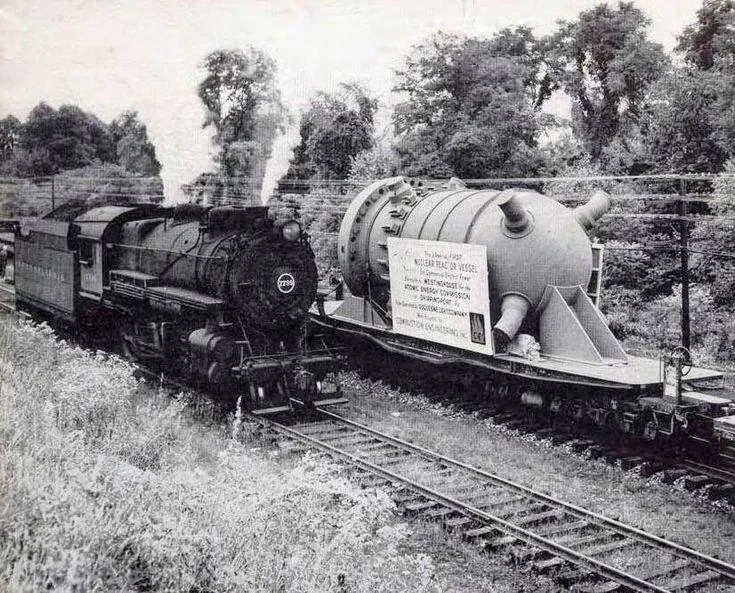
Derail Valley Simulator won’t let you drive that exact steam engine, but it simulates Diesel, Steam, and an Electric engine quite satisfactorily. To the point that I can’t use the steam engines without blowing them up accidentally.
But more seriously, watch the water in your sight glass, keep it about 3/4 full at all times and check it like you check your rear view mirror in your car, and don’t forget to open the cylinder cocks every time you stop (or at least when you first start moving) and you should be pretty good to avoid unexpected damage to your locomotive!
Did you mean to say a nuclear reactor being delivered by steam engine?
It’s a great photo though, kinda nuts how fast things moved then. It also reminds me of that story of a Chinese train driver standing next to the train he drives a few decades apart, from steam to high speed rail.China was notably one of the last places on earth to retire steam locomotives from revenue service, only ending mainline steam in 2005 and reportedly ending the last branchline’s use of steam in 2023, but may still have some revenue steam service surviving elsewhere
Bosnia still has some revenue steam service at a coal mine (notably running locomotives built by Germany using prisoner labor during WWII that were designed to use minimal resources and with a design life of only 10 years)
I wonder if nuclear would get more traction If it was pitched as enhanced steam power instead
“It’s a blockchain of an highly enhanced hydrogen process. Thanks to its AI quantum mechanism it manages to increase the energy output by a ton through its cloud.”
Just tell that to investors and they’ll gobble it up. /s
Needs some ai in there
Done!
INVEST
Where’s the cloud? The cloud has to be involved somehow.
Back to steam with the clouds here…
Yeah, sure, but I’m just not seeing enough labubu in your concept.
I wonder how fast we could get a steam train to go if we stuck a suitably shaped non-critical amount of plutonium in the firebox.
And replace the pistons with a turbine…
And replace the locomotive with a Delorean.
Then it’ll only get up to 88 mph.
What does a mile per hour really even mean when you can turn back time? 🤔️
As fast as it will roll down a hill. A non-critical mass of plutonium isn’t going to produce any significant heat for the boiler.
if we stuck a suitably shaped non-critical amount of plutonium in the firebox.
Non-critical? There isn’t much energy released from natural decay compared to criticality. We created things like this to power space probes like the Voyager I and II craft. 4.5kg of this Plutonium created about 2500w of thermal energy the the beginning of its life and the power declines from there.
So I need 80 tons of it in my firebox?
Well, you’d then have another problem. Unlike coal/wood/oil fuel, you can’t turn off radioactive decay.
You’d have megawatts (gigawatts?) of thermal energy boiling off all your water pretty quickly, and likely eventually melting down your steam engine firebox, and it would be that hot for decades!
You can boost it by hollowing out the middle and filling it with tritium, but plutonium is dense, so 80 tons will probably fit in the firebox just fine.
but plutonium is dense, so 80 tons will probably fit in the firebox
I feel like there’s a thing that will happen when I put that much in such a comparatively small place.
It’ll heat up the firebox, which is exactly what the firebox wants to happen. It’s not like we’re using precisely-timed explosives to briefly make the mass much more than critical and counter its desire to blow itself apart for long enough that it blows other things apart, too.
Nuclear Powered Steam Locomotives
Pros:
- Looks cool as hell.
- Only needs to be refuled every 25 years.
- It’s a steam locomotive.
- It’s a steam locomotive.
- Did I mention it’s a steam locomotive?
Cons:
- Have to replace the fireman with a nuclear engineer.
- Still have to stop to grease bearings and take on water periodically.
- Hazardous radioactive materials.
Pros clearly outweigh the cons. What are we waiting for?
Hilariously this was a plot point in a book I read recently. Isambard Kingdom Brunel replaced the firebox with some poorly shielded uranium, but the initial locomotive that was to demonstrate the technology was sabotaged and exploded, killing his parents.
This same book also had a fictional mad inventor who created a part newt-human hybrid named Victoria with womanly assets if you catch my drift, who upon failing to educate it he sent to a brothel because he couldn’t stand to “dispose of it” but when the princess and heir to the throne Elizabeth went missing, the newt-human hybrid Victoria was installed on the throne to prevent a constitutional crisis. And this is all events that occurred in the first 2 pages, so I’m not even spoiling anything!
spoilers for ending of the story Victoria in A Steampunk Trilogy
To spoil where the Queen to be Victoria was so well hidden that she couldn’t be found, she was in fact working in the newt-human hybrid Victoria’s room at the brothel! Seriously bonkers stories in that book!
aaaaand saved
I’ll be real, I absolutely loved the first story, it took a little bit to get into the second one (but thoroughly enjoyed it after all) and I gave up partway through the third one because I was struggling to get pulled in and my library book was due soon anyways. So absolutely worth it for the first two stories at least, and hopefully you enjoy the third one more than I did!
Reading the comments, it would seem most everyone here thinks that the usefulness of the steam is done when it gets used to turn a turbine at high pressure.
The steam can be used for much more than once. In the 1800’s and early 1900s when steam ran trains and ships, they built double and triple expansion engines that took the energy of the steam two and three times before it was done. It doesn’t need to be one and done. And when the energy is done being harvested for power generation, it can used for other things. Engineers today aren’t dumber than the ones in the 1800s.
I can remember a small rural Minnesota town that had their own coal fired electric plant. (Built back before the REA was a thing). They took the left over steam from power generation and then piped it to around 200 homes in the town and heated them with the leftover steam. While a bit costly to install, it was dirt cheap to run. Those homes lost all that when the power plant was shut down and they had to switch to either natural gas, fuel oil, LP, or electricity.
So don’t get hung up on just the power generation. Think what could be beyond that point.
Also the water is just a medium for energy transfer; it can be reused & recycled in near perpetuity in a closed system.
We’re used to open systems with water in power stations, including cooling towers etc, because water is abundant on earth so it’s cheaper to just dump it back into the atmosphere; we probably take the whole thing for granted.
But it could be engineered to be a closed system a bit like a coolant in a refrigeration unit cycling back and forth. And it probably will need to be a closed system in the future in space where water will be incredibly precious.
Municipal steam networks are still operating today.
For new infrastructure, Electricity is just so good-enough, that it is hard to justify building out partial alternatives like steam pipes. But where we already have them, they are still useful.
The same principal has been tried with crypto mining to reduce waste / cost.
Capture the heat and use it elsewhere like to heat the building.
Downside for heating buildings though is unless you’re doing it somewhere where it’s always cold, you eventually still end up with heat you can’t use, and at that scale, there’s better heating choices. I heard the city of vancouver was looking into heating a swimming pool with it, at least that would have a constant use.
Then you still end up with the issue of the mining cards only being good for 2-3 years before the tech improves and they aren’t mining efficiently anymore, which then just leads to more e-waste.
But imagine if the cards themselves had a really long useful life or were super cheap and easily recyclable, we could put miners in things like space / baseboard heaters which were already going to be doing resistive heating and then gain something from that instead of just heat.
Imagine doing something like having a GPU based baseboard heater that folds proteins whenever it’s on, where it doesn’t become completely obsolete in a couple years. If the chips were cheap enough it’d be way better than just doing heat.
Edit: Taking the idea further… imagine if governments mandated reuse of the heat generated by data centers instead of piping it outside? You want to build a data center here? Build a public pool and heat the building / water with your excess heat. Then that commercial zone also gets a fitness center for anyone nearby.
A good example of how you can do amazing things with steam is looking at the very last of the steam locomotives. Before they switched to diesel or electric, the steam locomotives were engineering masterpieces. Yes, you still got the classic steam locomotive puffs of steam coming out of the locomotive, but they only let the steam go once they had extracted the maximum possible energy from it.
Here’s a good video going over the whole design.
All large cities in Finland are heated by combined heat and power (CHP) power plants.
These power plants first make super heated steam (like 800°C, 1500°F), runs that through turbine to make electricity, then send the cooled down water (80-150°C, 170°F-300°F) to all homes through district heating grid.
From that water the home is heated and hot water is used.
Now that we have the district heating network, when electricity is cheap, we can also use electricity to boil the water and send it through the grid. Water is also easy to use as storage, if the need of consumption requires buffering.
Smaller cities use just heat plants, were there is no turbine for electricity generation, just the heating of water to district heating grid.
Most plants use biomass as power source in the power plants, historically they were coal, but it has been now almost completely phased out.
Steam had several technical and power limitations. It was dropped very quickly when electrification was an option.
Low key this is a great way to convince people to switch away from fossil fuels.
Most people seemingly don’t know that coal/gas stations work by essentially boiling water. Most are horrified at how trashy and underdeveloped the concept is compared to high tech alternatives like solar, wind, or hydro.
Well, hydro is just spinning water again, wind is spinning air. Solar is stealing electrons from the sun (i think?) So that’s cool
Well, the sun is sending them to us, so it’s not really stealing!
I promise I’ll return them when I’m done with them.
stealing
reappropriating :D
Getting electronics knocked around by photons.
Domestic Appliance Violence
Agree, the quantum-chem of it is amazing… Then again, solar has an efficiency of ~30% compared to the 90% for spinning steam
I don’t think it makes sense to compare those efficiencies, as one is for converting heat to electricity, while the other is for converting sunlight. If you use sunlight to heat water and then use that for a steam turbine, the efficiency is similar to a photovoltaic panel. The efficiency numbers are still useful, but only when they refer to the same starting point for the conversion (e.g. only comparing things that turn heat into electricity).
Yeah, it’s comparing apples to crabs. It’s only looking at the very final stage and ignoring the efficiencies of the fuel, etc.
If you wanted to make the comparison more fair (and also show how bad it is), a coal power plant maybe has an efficiency of 35%. You can calculate that by dividing the thermal energy in by the electric energy out. You feed in enough coal to generate 8MW of heat, which generates 2.8MW of electricity, so 2.8/8 = 0.35. By contrast, a photovoltaic power plant generates say 2kW of electricity with 0 fuel, so it has an efficiency of ∞%.
You are right it doesnt really makes sense to compare them that way, it was just what the initial comment was doing. Nuclear fission is in itself only like 30% efficient. There are of course tons of metrics to compare these things, I personally like space-time efficiency or CO2/MWh.
But it’s all profit baby! Let something else figure out cousin, put 0% effort in and collect the rewards!
but crucially no moving parts. very little maintenance, especially compared to anything steam driven.
I am a big solar fan, but the moving part inertia thing is actually great for stabilizing the grid.
They pump water through it. The water gives energy, all our energy is hydrogen baby
You can transfer gas to electricity without boiling water. But it is much more efficient to combine it with boiling water
Hydrohomies!

We need this on lemmy
We have it already! ^^ <3
We live in a Steampunk world without Steampunk aesthetics. 😩
Cyberpunk-lite 😔
We don’t even deserve that much credit. We’re still mostly wearing the same clothes that we wore in the 70s…
“Dyson Spheres? Look, playing with sunlight and mirrors was a fun side project, but you want to know a much more advanced method of generating power?”
“Please dont…”
“Thats right! By hurling entire water worlds into a star, we then capture the released steam which powers our gravitationally locked dynamo network.”
Throwing water into a star wouldn’t get you steam, it’d just fuel the star XD
You gotta seal the planet in a heat-safe bag, and make sure to not drop it out of orbit, or you’ll lose the water, as you say.
Nah. You’ll probably want several shells operating above any sane temperature for steam. You don’t want to lose that extremely high temperature by just heating water to 600 °C or so.
It’s always been about finding new ways to spin a turbine
There’s only 3 major ways to transform different forms of energy into electricity, which are:
- solar panels (light -> electricity)
- mechanical engines/generators (mechanical movement -> electricity)
- electrochemical battery (chemical dipole -> electricity)
there’s a whole lot more, such as thermoelectric generator and piezoelectricity but these are the three significant ones.
note that i distinguish these categories by their core essence, such as whether they’re using changes in magnetic flux (like a mechanical generator) or transferring 1 photon on each electron (like solar panels), instead of looking at what source type of energy they transform.
because there’s many ways to transform e.g. light energy into electricity. you could also heat water with the sunlight and then drive a steam engine with it. but that’s not what i care about. i care about the fundamental connection between different types of energy, and how they can be directly transformed to one another.
https://en.wikipedia.org/wiki/Radioisotope_thermoelectric_generator
https://en.wikipedia.org/wiki/Betavoltaic_device
We use steam because it is very efficient and lowest cost to maintain.
Living somewhere that makes 90+% of its electricity from hydro, I am slightly confused.
Most modern means of electricity production involve creating heat in some way, then using that heat to boil water, creating steam. That steam is then used to turn a turbine, which generates electricity.
use cherenkov radiation to power photovoltaic array.
Yeah but photovoltaic has a yield of less than 50% even for the best panels. Lots of waste there, compared to steam.
What is the peak efficiency of steam turbines?
Supercritical steam is nothing to fuck with. Even old school sub critical steam will happily kill you as if it were fire instead of water.
Edit
Utility steam turbines operate with inlet steam pressures up to 3500 psig and exhaust at vacuum conditions as low as 2 psia
Damn
There are actually versions of fusion reactors that use the magnetic fields generated by the plasma in order to make electricity directly.